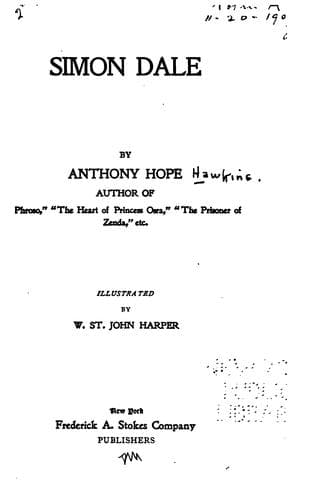
Great Britain -- History -- Charles II, 1660-1685 -- Fiction
"Your Grace has my hand prisoner. You can work your will on it."
"Your hand! I mean your lips this time," he cried in audacious
insolence. He came nearer to her, his arm crept round her waist. I had
endured what I could, yes, and as long as I could; for I was persuaded
that I could serve her better by leaving her unaided for the moment. But
my limit was reached; I stepped out from behind the chair. But in an
instant I was back again. Monmouth had paused; in one hand he held
Barbara's hand, the other rested on her girdle, but he turned his head
and looked at the stairs. Voices had come from there; he had heard them
as I had, as Barbara had.
"You can't pass out," had come in a blustering tone from Carford.
"Stand aside, sir," was the answer in a calm, imperative voice.
Carford hesitated for a single instant, then he seemed to shrink away,
making himself small and leaving free passage for a man who came down
the steps and walked confidently and briskly across the hall towards
where the Duke stood with Barbara.
Above us, at the top of the stairs, there were the sound of voices and
the tread of feet. The conference was broken up and the parties to it
were talking in the passage on their way to regain their own apartments.
I paid no heed to them; my eyes were fixed on the intruder who came so
boldly and unabashed up to the Duke. I knew him now; he was M. de
Perrencourt, Madame's gentleman.
Without wavering or pausing, straight he walked. Monmouth seemed turned
to stone; I could see his face set and rigid, although light failed me
to catch that look in the eyes by which you may best know a man's mood.
Not a sound or a motion came from Carford. Barbara herself was stiff and
still, her regard bent on M. de Perrencourt. He stood now directly over
against her and Monmouth; it seemed long before he spoke. Indeed, I had
looked for Monmouth's voice first, for an oath of vexation at the
interruption, for a curse on the intruder and a haughty order to him to
be gone and not interfere with what concerned his betters. No such word,
nor any words, issued from the mouth of the Duke. And still M. de
Perrencourt was silent. Carford stole covertly from the steps nearer to
the group until, gliding across the hall, he was almost at the
Frenchman's elbow. Still M. de Perrencourt was silent.
Slowly and reluctantly, as though in deference to an order that he
loathed but dared not disobey, Monmouth drew his arm away; he loosed
Barbara's hand, she drew back, leaning against the wall; the Duke stood
with his arms by his side, looking at the man who interrupted his sport
and seemed to have power to control his will. Then, at last, in crisp,
curt, ungracious tones, M. de Perrencourt spoke.
"I thank you, Monsieur le Duc," said he. "I was sure that you would
perceive your error soon. This is not the lady you supposed, this is
Mistress Quinton. I desire to speak with her, pray give me leave."
Public-domain text, read in full here on John Shaqi.
Reviews
Reviews
No reviews yet
Be the first to share your thoughts on this work.
Elsewhere in the archive
Join the Discussion
Join the discussion
Sign in to leave a comment or review.
Sign InorCreate an account