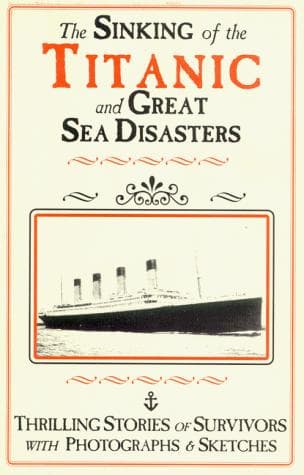
Shipwrecks -- North Atlantic Ocean; Titanic (Steamship)
Mr. William E. Carter, of Bryn Mawr, who, with his family, was saved,
confirmed Mr. Ismay's assertions.
"Mr. Ismay's statement is absolutely correct," said Mr. Carter. "There
were no women on the deck when that boat was launched. We were the very
last to leave the deck, and we entered the life-boat because there were
no women to enter it.
"The deck was deserted when the boat was launched, and Mr. Ismay and
myself decided that we might as well enter the boat and pull away from
the wreck. If he wants me, I assume that he will write to me.
"I can say nothing, however, that he has not already said, as our
narratives are identical; the circumstances under which we were rescued
from the Titanic were similar. We left the boat together and were picked
up together, and, further than that, we were the very last to leave the
deck.
"I am ready to go to Washington to testify to the truth of Mr. Ismay's
statement, and also to give my own account at any time I may be called
upon. If Mr. Ismay writes to me, asking that I give a detailed account
of our rescue I will do so."
CHAPTER XXIII. THE FINANCIAL LOSS
TITANIC NOT FULLY INSURED--VALUABLE CARGO AND MAIL--NO CHANCE FOR
SALVAGE--LIFE INSURANCE LOSS--LOSS TO THE CARPATHIA
SO great was the interest in the tragedy and so profound the grief at
the tremendous loss of life that for a time the financial loss was
not considered. It was, however, the biggest ever suffered by marine
insurance brokers.
The value of the policy covering the vessel against all ordinary risks
was $5,000,000, but the whole of this amount was not insured, because
British and Continental markets were not big enough to swallow it.
The actual amount of insurance was $3,700,000, of which the owners
themselves held $750,000.
As to the cargo, it was insured by the shippers. The company has nothing
to do with the insurance of the cargo, which, according to the company's
manifest, was conservatively estimated at about $420,000. Cargo,
however, was a secondary matter, so far as the Titanic was concerned.
The ship was built for high-priced passengers, and what little cargo
she carried was also of the kind that demanded quick transportation.
The Titanic's freight was for the most part what is known as high-class
package freight, consisting of such articles as fine laces, ostrich
feathers, wines, liquors and fancy food commodities.
LOST MAIL MAY COST MILLIONS
Prior to the sailing of the vessel the postal authorities of Southampton
cabled the New York authorities that 3435 bags of mail matter were on
board.
"In a load of 3500 bags," said Postmaster Morgan, of New York, "it is
a safe estimate to say that 200 contained registered mail. The size of
registered mail packages varies greatly, but 1000 packages for each
mail bag should be a conservative guess. That would mean that 200,000
registered packages and letters went down with the Titanic.
Public-domain text, read in full here on John Shaqi.
Reviews
Reviews
No reviews yet
Be the first to share your thoughts on this work.
Elsewhere in the archive
Join the Discussion
Join the discussion
Sign in to leave a comment or review.
Sign InorCreate an account