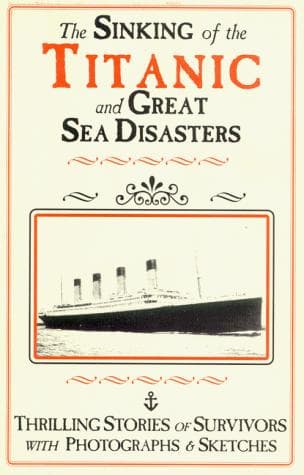
Shipwrecks -- North Atlantic Ocean; Titanic (Steamship)
"Now," repeated Senator Smith, "suppose the weather was clear and the
sky unruffled, as it was at the time of the disaster, how many would the
boat hold?"
"Really, I don't know. It would depend largely upon the people who
were to enter. If they did as they were told I believe each boat could
accommodate sixty-five persons."
Boxhall testified to the sobriety and good habits of his superior and
brother officers.
NO TRACE OF DAMAGE INSIDE
Boxhall said he went down to the steerage, inspected all the decks in
the vicinity of where the ship had struck, found no traces of any damage
and went directly to the bridge and so reported.
CARPENTER FOUND LEAKS
"The captain ordered me to send a carpenter to sound the ship, but I
found a carpenter coming up with the announcement that the ship was
taking water. In the mail room I found mail sacks floating about while
the clerks were at work. I went to the bridge and reported, and the
captain ordered the life-boats to be made ready."
Boxhall testified that at Captain Smith's orders he took word of the
ship's position to the wireless operators.
"What position was that?"
"Forty-one forty-six north, fifty fourteen west."
"Was that the last position taken?"
"Yes, the Titanic stood not far from there when she sank."
After that Boxhall went back to the life-boats, where there were many
men and women. He said they had been provided with life-belts.
{illust. caption = THE EFFECTS OF STRIKING AN ICEBERG
(1) Shows normal....}
DISTRESS ROCKETS FIRED
"After that I was on the bridge most of the time sending out distress
signals, trying to attract the attention of boats ahead," he said. "I
sent up distress rockets until I left the ship, to try to attract the
attention of a ship directly ahead. I had seen her lights. She seemed to
be meeting us and was not far away. She got close enough, so she seemed
to me, to read our Morse electric signals."
"Suppose you had a powerful search light on the Titanic, could you not
have thrown a beam on the vessel and have compelled her attention?"
"We might."
H. J. Pitman, the third officer of the ship, was the first witness on
April 23d. By a series of searching questions Senator Fletcher brought
out the fact that when the collision occurred the Titanic was going at
the greatest speed attained during the trip, even though the ship was
entering the Grand Banks and had been advised of the presence of ice.
Frederick Fleet, a sailor and lookout man on the Titanic, followed
Pitman on the stand. Fleet said he had had five or six years' experience
at sea and was lookout on the Oceanic prior to going on the Titanic. He
was in the crow's nest at the time of the collision.
Fleet stated that he had kept a sharp lookout for ice, and testified to
seeing the iceberg and signaling the bridge.
Public-domain text, read in full here on John Shaqi.
Reviews
Reviews
No reviews yet
Be the first to share your thoughts on this work.
Elsewhere in the archive
Join the Discussion
Join the discussion
Sign in to leave a comment or review.
Sign InorCreate an account