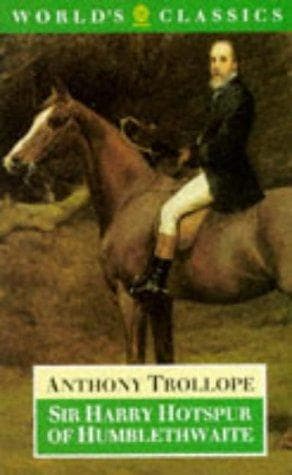
Sir Harry Hotspur of HumblethwaiteTrollope, Anthony
General
Sir Harry Hotspur of Humblethwaite
Trollope, Anthony
Cumberland (England) -- Fiction; Domestic fiction; Fathers and daughters -- Fiction; Inheritance and succession -- Fiction
Cousin George was profuse in declaring that he would be at his
cousin's disposal at any hour Sir Harry might select, from six in the
morning throughout the day and night. But might he not say a word to
Emily? At this proposition Lady Elizabeth shook her head vigorously.
It was quite out of the question. Circumstanced as they all were at
present, Sir Harry would not think of such a thing. And then it would
do no good. Lady Elizabeth did not believe that Emily herself would
wish it. At any rate there need be no further talk about it, as
any such interview was at present quite impossible. By all which
arguments and refusals, and the tone in which they were pronounced,
Cousin George was taught to perceive that, at any rate in the mind
of Lady Elizabeth, the process of parental yielding had already
commenced.
On all such occasions interviews are bad. The teller of this story
ventures to take the opportunity of recommending parents in such
cases always to refuse interviews, not only between the young lady
and the lover who is to be excluded, but also between themselves and
the lover. The vacillating tone,--even when the resolve to suppress
vacillation has been most determined,--is perceived and understood,
and at once utilized, by the least argumentative of lovers, even by
lovers who are obtuse. The word "never" may be so pronounced as to
make the young lady's twenty thousand pounds full present value for
ten in the lover's pocket. There should be no arguments, no letters,
no interviews; and the young lady's love should be starved by the
absence of all other mention of the name, and by the imperturbable
good humour on all other matters of those with whom she comes in
contact in her own domestic circle. If it be worth anything, it won't
be starved; but if starving to death be possible, that is the way to
starve it. Lady Elizabeth was a bad ambassador; and Cousin George,
when he took his leave, promising to be ready to meet Sir Harry at
twelve on the morrow, could almost comfort himself with a prospect
of success. He might be successful, if only he could stave off
the Walker and Bullbean portion of Mr. Hart's persecution! For he
understood that the success of his views at Humblethwaite must
postpone the payment by Sir Harry of those moneys for which Mr. Hart
and Captain Stubber were so unreasonably greedy. He would have dared
to defy the greed, but for the Walker and Bullbean portion of the
affair. Sir Harry already knew that he was in debt to these men;
already knew with fair accuracy the amount of those debts. Hart and
Stubber could not make him worse in Sir Harry's eyes than he was
already, unless the Walker and Bullbean story should be told with the
purpose of destroying him. How he did hate Walker and Bullbean and
the memory of that evening;--and yet the money which now enabled him
to drink champagne at the Penrith Crown was poor Mr. Walker's money!
As he was driven back to Penrith he thought of all this, for some
Public-domain text, read in full here on John Shaqi.
Reviews
Reviews
No reviews yet
Be the first to share your thoughts on this work.
Elsewhere in the archive
Join the Discussion
Join the discussion
Sign in to leave a comment or review.
Sign InorCreate an account