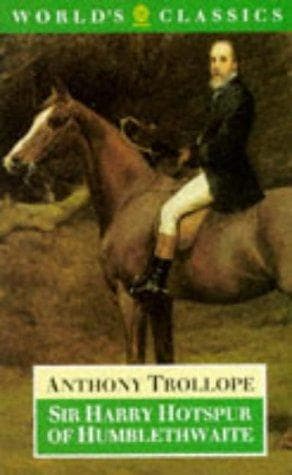
Sir Harry Hotspur of HumblethwaiteTrollope, Anthony
General
Sir Harry Hotspur of Humblethwaite
Trollope, Anthony
Cumberland (England) -- Fiction; Domestic fiction; Fathers and daughters -- Fiction; Inheritance and succession -- Fiction
She was told that her lover would renounce her, but she would not
believe what she was told. Of course he would accept the payment
of his debts. Of course he would take an income when offered to
him. What else was he to do? How was he to live decently without
an income? All these evils had happened to him because he had been
expected to live as a gentleman without proper means. In fact, he was
the person who had been most injured. Her father, in his complete, in
his almost abject tenderness towards her, could not say rough words
in answer to all these arguments. He could only repeat his assertion
over and over again that the man was utterly unworthy of her, and
must be discarded. It was all as nothing. The man must discard
himself.
"He is false as hell," said Sir Harry.
"And am I to be as false as hell also? Will you love me better when I
have consented to be untrue? And even that would be a lie. I do love
him. I must love him. I may be more wicked than he is, because I do
so. But I do."
Poor Lady Elizabeth in these days was worse than useless. Her
daughter was so strong that her weakness was as the weakness of
water. She was driven hither and thither in a way that she herself
felt to be disgraceful. When her husband told her that the cousin, as
matter of course, could never be seen again, she assented. When Emily
implored her to act as mediator with her father on behalf of the
wicked cousin, she again assented. And then, when she was alone with
Sir Harry, she did not dare to do as she had promised.
"I do think it will kill her," she said to Sir Harry.
"We must all die, but we need not die disgraced," he said.
It was a most solemn answer, and told the thoughts which had been
dwelling in his mind. His son had gone from him; and now it might
be that his daughter must go too, because she could not survive
the disappointment of her young love. He had learned to think that
it might be so as he looked at her great grave eyes, and her pale
cheeks, and her sorrow-laden mouth. It might be so; but better that
for them all than that she should be contaminated by the touch of
a thing so vile as this cousin. She was pure as snow, clear as a
star, lovely as the opening rosebud. As she was, let her go to her
grave,--if it need be so. For himself, he could die too,--or even
live if it were required of him! Other fathers, since Jephtha and
Agamemnon, have recognised it as true that heaven has demanded from
them their daughters.
The letter came, and was read and re-read by Sir Harry before he
showed it to his child. He took it also to his wife, and explained it
to her in all its points. "It has more craft," said he, "than I gave
him credit for."
"I don't suppose he ever cared for her," said Lady Elizabeth.
"Nor for any human being that ever lived,--save himself. I wonder
whether he got Boltby to write it for him."
"Surely Mr. Boltby wouldn't have done that."
Public-domain text, read in full here on John Shaqi.
Reviews
Reviews
No reviews yet
Be the first to share your thoughts on this work.
Elsewhere in the archive
Join the Discussion
Join the discussion
Sign in to leave a comment or review.
Sign InorCreate an account