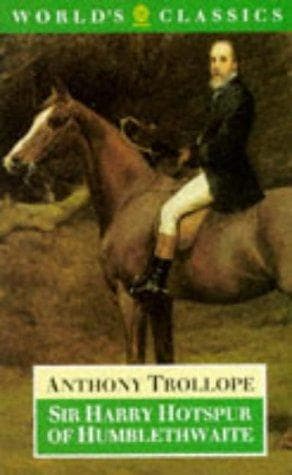
Sir Harry Hotspur of HumblethwaiteTrollope, Anthony
General
Sir Harry Hotspur of Humblethwaite
Trollope, Anthony
Cumberland (England) -- Fiction; Domestic fiction; Fathers and daughters -- Fiction; Inheritance and succession -- Fiction
Early in the day she went out by herself. It was now December, but
the weather was fine and dry, and she was for two hours alone,
rambling through the park. She had made her attempt in life, and had
failed. She owned her failure to herself absolutely. The image had no
gold in it;--none as yet. But it was not as other images, which, as
they are made, so must they remain to the end. The Divine Spirit,
which might from the first have breathed into this clay some particle
of its own worth, was still efficacious to bestow the gift. Prayer
should not be wanting; but the thing as it now was she saw in all its
impurity. He had never loved her. Had he loved her he would not have
written words such as those she had read. He had pretended to love
her in order that he might have money, that his debts might be paid,
that he might not be ruined. "He hoped," he said in his letter, "he
hoped that his cousin might be made happy by a splendid alliance!"
She remembered well the abominable, heartless words. And this was
the man who had pledged her to truth and firmness, and whose own
truth and firmness she had never doubted for a moment, even when
acknowledging to herself the necessity of her pledge to him. He had
never loved her; and, though she did not say so, did not think so,
she felt that of all his sins that sin was the one which could not be
forgiven.
What should she now do with herself,--how bear herself at this
present moment of her life? She did not tell herself now that she
would die, though as she looked forward into life all was so dreary
to her, that she would fain have known that death would give an
escape. But there were duties for her still to do. During that winter
ramble, she owned to herself for the first time that her father had
been right in his judgment respecting their cousin, and that she, by
her pertinacity, had driven her father on till on her account he had
been forced into conduct which was distasteful to him. She must own
to her father that he had been right; that the man, though she dearly
loved him still, was of such nature that it would be quite unfit that
she should marry him. There might still be the miracle; her prayers
were still her own to give; of them she would say nothing to her
father. She would simply confess to him that he had been right, and
then beg of him to pardon her the trouble she had caused him.
"Papa," she said to him the following morning, "may I come to you?"
She came in, and on this occasion sat down at his right hand. "Of
course, you have been right, Papa," she said.
"We have both been right, dearest, I hope."
"No, Papa; I have been wrong! I thought I knew him, and I did not. I
thought when you told me that he was so bad, that you were believing
false people; and, Papa, I know now that I should not have loved him
as I did;--so quickly, like that."
"Nobody has blamed you for a moment. Nobody has thought of blaming
you."
Public-domain text, read in full here on John Shaqi.
Reviews
Reviews
No reviews yet
Be the first to share your thoughts on this work.
Elsewhere in the archive
Join the Discussion
Join the discussion
Sign in to leave a comment or review.
Sign InorCreate an account