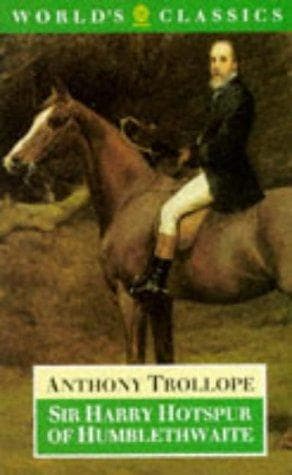
Sir Harry Hotspur of HumblethwaiteTrollope, Anthony
General
Sir Harry Hotspur of Humblethwaite
Trollope, Anthony
Cumberland (England) -- Fiction; Domestic fiction; Fathers and daughters -- Fiction; Inheritance and succession -- Fiction
The scene which took place that night between the mother and daughter
may be easily conceived. Emily told her tale, and told it in a manner
which left no doubt of her persistency. She certainly meant it. Lady
Elizabeth had almost expected it. There are evils which may come or
may not; but as to which, though we tell ourselves that they may
still be avoided, we are inwardly almost sure that they will come.
Such an evil in the mind of Lady Elizabeth had been Cousin George.
Not but what she herself would have liked him for a son-in-law had it
not been so certain that he was a black sheep.
"Your father will never consent to it, my dear."
"Of course, Mamma, I shall do nothing unless he does."
"You will have to give him up."
"No, Mamma, not that; that is beyond what Papa can demand of me. I
shall not give him up, but I certainly shall not marry him without
Papa's consent, or yours."
"Nor see him?"
"Well; if he does not come I cannot see him."
"Nor correspond with him?"
"Certainly not, if Papa forbids it."
After that, Lady Elizabeth did give way to a considerable extent.
She did not tell her daughter that she considered it at all probable
that Sir Harry would yield; but she made it to be understood that
she herself would do so if Sir Harry would be persuaded. And she
acknowledged that the amount of obedience promised by Emily was all
that could be expected. "But, Mamma," said Emily, before she left her
mother, "do you not know that you love him yourself?"
"Love is such a strong word, my dear."
"It is not half strong enough," said Emily, pressing her two hands
together. "But you do, Mamma?"
"I think he is very agreeable, certainly."
"And handsome?--only that goes for nothing."
"Yes, he is a fine-looking man."
"And clever? I don't know how it is; let there be who there may in
the room, he is always the best talker."
"He knows how to talk, certainly."
"And, Mamma, don't you think that there is a something,--I don't know
what,--something not at all like other men about him that compels
one to love him? Oh, Mamma, do say something nice to me! To me he is
everything that a man should be."
"I wish he were, my dear."
"As for the sort of life he has been leading, spending more money
than he ought, and all that kind of thing, he has promised to reform
it altogether; and he is doing it now. At any rate, you must admit,
Mamma, that he is not false."
"I hope not, my dear."
"Why do you speak in that way, Mamma? Does he talk like a man that
is false? Have you ever known him to be false? Don't be prejudiced,
Mamma, at any rate."
The reader will understand that when the daughter had brought her
mother as far as this, the elder lady was compelled to say "something
nice" at last. At any rate there was a loving embrace between them,
and an understanding that the mother would not exaggerate the
difficulties of the position either by speech or word.
"Of course you will have to see your papa to-morrow morning," Lady
Elizabeth said.
Public-domain text, read in full here on John Shaqi.
Reviews
Reviews
No reviews yet
Be the first to share your thoughts on this work.
Elsewhere in the archive
Join the Discussion
Join the discussion
Sign in to leave a comment or review.
Sign InorCreate an account