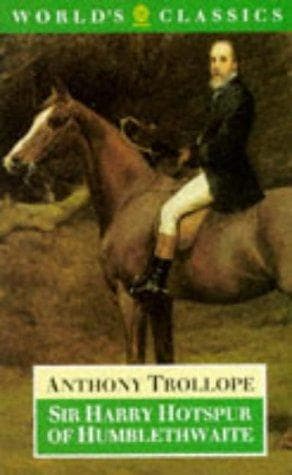
Sir Harry Hotspur of HumblethwaiteTrollope, Anthony
General
Sir Harry Hotspur of Humblethwaite
Trollope, Anthony
Cumberland (England) -- Fiction; Domestic fiction; Fathers and daughters -- Fiction; Inheritance and succession -- Fiction
He understood it all immediately. The Stackpooles had been at
Humblethwaite. But what business had the man to write letters to him
with the object of getting him into trouble? He did not answer the
note, but, nevertheless, it annoyed him much. And then there was
another great vexation. He was now running low in funds for present
use. He had made what he feared was a most useless outlay in
satisfying Stubber's immediate greed for money, and the effect was,
that at the beginning of the last week in September he found himself
with hardly more than fifty sovereigns in his possession, which would
be considerably reduced before he could leave town. He had been worse
off before,--very much worse; but it was especially incumbent on him
now to keep up that look of high feather which cannot be maintained
in its proper brightness without ready cash. He must take a
man-servant with him among the distinguished guests; he must fee
gamekeepers, pay railway fares, and have loose cash about him for
a hundred purposes. He wished it to be known that he was going to
marry his cousin. He might find some friend with softer heart than
Altringham, who would lend him a few hundreds on being made to
believe in this brilliant destiny; but a roll of bank-notes in his
pocket would greatly aid him in making the destiny credible. Fifty
pounds, as he well knew, would melt away from him like snow. The
last fifty pounds of a thousand always goes quicker than any of the
nineteen other fifties.
Circumstances had made it impossible for him to attend the Leger
this year, but he had put a little money on it. The result had done
nothing for or against him,--except this, that whereas he received
between one and two hundred pounds, he conceived the idea of paying
only a portion of what he had lost. With reference to the remainder,
he wrote to ask his friend if it would be quite the same if the money
were paid at Christmas. If not, of course it should be sent at once.
The friend was one of the Altringham set, who had been at Castle
Corry, and who had heard of George's hopes in reference to his
cousin. George added a postscript to his letter: "This kind of thing
will be over for me very soon. I am to be a Benedict, and the house
of Humblethwaite and the title are to be kept together. I know you
will congratulate me. My cousin is a charming girl, and worth all
that I shall lose ten times over." It was impossible, he thought,
that the man should refuse him credit for eighty pounds till
Christmas, when the man should know that he was engaged to be married
to £20,000 a year! But the man did refuse. The man wrote back to say
that he did not understand this kind of thing at all, and that he
wanted his money at once. George Hotspur sent the man his money, not
without many curses on the illiberality of such a curmudgeon. Was it
not cruel that a fellow would not give him so trifling an assistance
when he wanted it so badly? All the world seemed to conspire to hurt
Public-domain text, read in full here on John Shaqi.
Reviews
Reviews
No reviews yet
Be the first to share your thoughts on this work.
Elsewhere in the archive
Join the Discussion
Join the discussion
Sign in to leave a comment or review.
Sign InorCreate an account