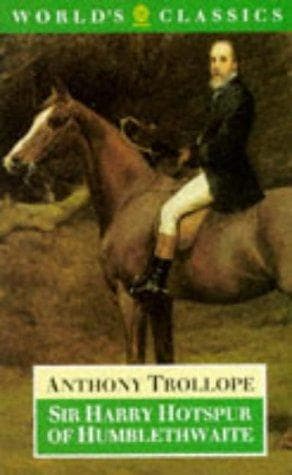
Sir Harry Hotspur of HumblethwaiteTrollope, Anthony
General
Sir Harry Hotspur of Humblethwaite
Trollope, Anthony
Cumberland (England) -- Fiction; Domestic fiction; Fathers and daughters -- Fiction; Inheritance and succession -- Fiction
Sir Harry, before he had left Humblethwaite for London in October,
had heard enough of his cousin's sins to make him sure that the
match must be opposed with all his authority. Indeed he had so felt
from the first moment in which George had begun to tell him of
what had occurred at Airey Force. He had never thought that George
Hotspur would make a fitting husband for his daughter. But, without
so thinking, he had allowed his mind to dwell upon the outside
advantages of the connection, dreaming of a fitness which he knew did
not exist, till he had vacillated, and the evil thing had come upon
him. When the danger was so close upon him to make him see what it
was, to force him to feel what would be the misery threatened to his
daughter, to teach him to realize his own duty, he condemned himself
bitterly for his own weakness. Could any duty which he owed to the
world be so high or so holy as that which was due from him to his
child? He almost hated his name and title and position as he thought
of the evil that he had already done. Had his cousin George been in
no close succession to the title, would he have admitted a man of
whom he knew so much ill, and of whom he had never heard any good,
within his park palings? And then he could not but acknowledge to
himself that by asking such a one to his house,--a man such as this
young cousin who was known to be the heir to the title,--he had given
his daughter special reason to suppose that she might regard him as
a fitting suitor for her hand. She of course had known,--had felt as
keenly as he had felt, for was she not a Hotspur?--that she would be
true to her family by combining her property and the title, and that
by yielding to such a marriage she would be doing a family duty,
unless there were reasons against it stronger than those connected
with his name. But as to those other reasons, must not her father and
her mother know better than she could know? When she found that the
man was made welcome both in town and country, was it not natural
that she should suppose that there were no stronger reasons? All this
Sir Harry felt, and blamed himself and determined that though he must
oppose his daughter and make her understand that the hope of such a
marriage must be absolutely abandoned, it would be his duty to be
very tender with her. He had sinned against her already, in that he
had vacillated and had allowed that handsome but vile and worthless
cousin to come near her.
In his conduct to his daughter, Sir Harry endeavoured to be just,
and tender, and affectionate; but in his conduct to his wife on
the occasion he allowed himself some scope for the ill-humour not
unnaturally incident to his misfortune. "Why on earth you should
have had him in Bruton Street when you knew very well what he was, I
cannot conceive," said Sir Harry.
"But I didn't know," said Lady Elizabeth, fearing to remind her
husband that he also had sanctioned the coming of the cousin.
Public-domain text, read in full here on John Shaqi.
Reviews
Reviews
No reviews yet
Be the first to share your thoughts on this work.
Elsewhere in the archive
Join the Discussion
Join the discussion
Sign in to leave a comment or review.
Sign InorCreate an account