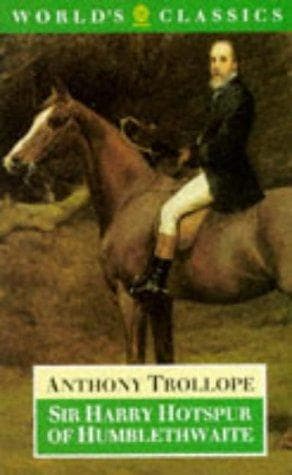
Sir Harry Hotspur of HumblethwaiteTrollope, Anthony
General
Sir Harry Hotspur of Humblethwaite
Trollope, Anthony
Cumberland (England) -- Fiction; Domestic fiction; Fathers and daughters -- Fiction; Inheritance and succession -- Fiction
He had sent for her into his own morning room, in which she did not
remember to have been asked to sit down before. She would often
visit him there, coming in and out on all manner of small occasions,
suggesting that he should ride with her, asking for the loan of a
gardener for a week for some project of her own, telling him of a big
gooseberry, interrupting him ruthlessly on any trifle in the world.
But on such occasions she would stand close to him, leaning on him.
And he would scold her,--playfully, or kiss her, or bid her begone
from the room,--but would always grant what she asked of him. To him,
though he hardly knew that it was so, such visits from his darling
had been the bright moments of his life. But up to this morning he
had never bade her be seated in that room.
"Emily," he said, "I hope you understand that all this about your
cousin George must be given up." She made no reply, though he waited
perhaps for a minute. "It is altogether out of the question. I am
very, very sorry that you have been subjected to such a sorrow. I
will own that I have been to blame for letting him come to my house."
"No, Papa, no."
"Yes, my dear, I have been to blame, and I feel it keenly. I did not
then know as much of him as I do now, but I had heard that which
should have made me careful to keep him out of your company."
"Hearing about people, Papa! Is that fair? Are we not always hearing
tales about everybody?"
"My dear child, you must take my word for something."
"I will take it for everything in all the world, Papa."
"He has been a thoroughly bad young man."
"But, Papa--"
"You must take my word for it when I tell you that I have positive
proof of what I am telling you."
"But, Papa--"
"Is not that enough?"
"No, Papa. I am heartily sorry that he should have been what you call
a bad young man. I wish young men weren't so bad;--that there were no
racecourses, and betting, and all that. But if he had been my brother
instead of my cousin--"
"Don't talk about your brother, Emily."
"Should we hate him because he has been unsteady? Should we not do
all that we could in the world to bring him back? I do not know that
we are to hate people because they do what they ought not to do."
"We hate liars."
"He is not a liar. I will not believe it."
"Why did he tell you that he was not at those races, when he was
there as surely as you are here? But, my dear, I will not argue about
all this with you. It is not right that I should do so. It is my duty
to inquire into these things, and yours to believe me and to obey
me." Then he paused, but his daughter made no reply to him. He looked
into her face, and saw there that mark about her eyes which he knew
he so often showed himself; which he so well remembered with his
father. "I suppose you do believe me, Emily, when I tell you that he
is worthless."
"He need not be worthless always."
"His conduct has been such that he is unfit to be trusted with
anything."
Public-domain text, read in full here on John Shaqi.
Reviews
Reviews
No reviews yet
Be the first to share your thoughts on this work.
Elsewhere in the archive
Join the Discussion
Join the discussion
Sign in to leave a comment or review.
Sign InorCreate an account