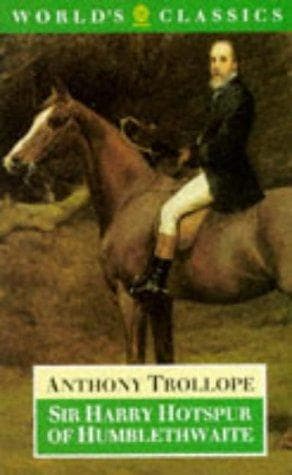
Sir Harry Hotspur of HumblethwaiteTrollope, Anthony
General
Sir Harry Hotspur of Humblethwaite
Trollope, Anthony
Cumberland (England) -- Fiction; Domestic fiction; Fathers and daughters -- Fiction; Inheritance and succession -- Fiction
When he met his daughter he had embraced her, and she had kissed
him and asked after his welfare; but he felt at once that she was
different from what she used to be,--different, not only as regarded
herself, but different also in her manner. There came upon him a sad,
ponderous conviction that the sunlight had gone out from their joint
lives, that all pleasant things were over for both of them, and that,
as for him, it would be well for him that he should die. He could
not be happy if there were discord between him and his child,--and
there must be discord. The man had been invited with a price to take
himself off, and had not been sufficiently ignoble to accept the
offer. How could he avoid the discord, and bring back the warmth of
the sun into his house? Then he remembered those terribly forcible
epithets which Mr. Boltby had spoken. "He is an unprincipled
blackguard; and the worse blackguard because of his birth." The words
had made Sir Harry angry, but he believed them to be true. If there
were to be any yielding, he would not yield as yet; but that living
in his house without sunshine was very grievous to him. "She will
kill me," he said to himself, "if she goes on like this."
And yet it was hard to say of what it was that he complained. Days
went by and his daughter said nothing and did nothing of which he
could complain. It was simply this,--that the sunshine was no longer
bright within his halls. Days went by, and George Hotspur's name had
never been spoken by Emily in the hearing of her father or mother.
Such duties as there were for her to do were done. The active duties
of a girl in her position are very few. It was her custom of a
morning to spread butter on a bit of toast for her father to eat.
This she still did, and brought it to him as was her wont; but
she did not bring it with her old manner. It was a thing still
done,--simply because not to do it would be an omission to be
remarked. "Never mind it," said her father the fourth or fifth
morning after his return, "I'd sooner do it for myself." She did
not say a word, but on the next morning the little ceremony, which
had once been so full of pleasant affection, was discontinued. She
had certain hours of reading, and these were prolonged rather than
abandoned. But both her father and mother perceived that her books
were changed; her Italian was given up, and she took to works of
religion,--sermons, treatises, and long commentaries.
"It will kill me," said Sir Harry to his wife.
"I am afraid it will kill her," said Lady Elizabeth. "Do you see how
her colour has gone, and she eats so little!"
"She walks every day."
"Yes; and comes in so tired. And she goes to church every Wednesday
and Friday at Hesket. I'm sure she is not fit for it such weather as
this."
"She has the carriage?"
"No, she walks."
Public-domain text, read in full here on John Shaqi.
Reviews
Reviews
No reviews yet
Be the first to share your thoughts on this work.
Elsewhere in the archive
Join the Discussion
Join the discussion
Sign in to leave a comment or review.
Sign InorCreate an account