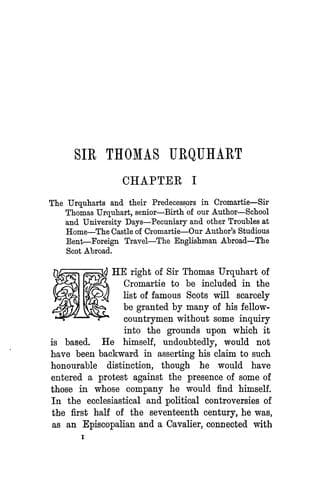
After giving a long list of his fellow-countrymen who had won fame in
foreign lands by their valour, learning, or skill, in order to put to
silence those who maligned his nation, Sir Thomas Urquhart takes up a
less pleasing topic--that of contemporary politics. In the plainest and
most forcible manner he repudiates the whole policy of the dominant
party in Scotland, and declares that a true Royalist or Malignant like
himself had much more in common with an Independent, than either of them
had with a Presbyterian; and he enlarges upon the turbulent disloyalty
with which so many of the last-named party had, in his opinion,
conducted themselves towards their sovereigns since Queen Mary's time,
evidently in forgetfulness for the moment that his newly-found friends,
the Independents, had executed Charles I. and abolished monarchy.
His account of the mode in which the Presbyterian or "Consistorian"
party were in the habit of treating their kings is very amusing. "Of a
king," he says, "they onely make use for their own ends, and so they
will of any other supreme magistracie that is not of their own erection.
Their kings are but as the kings of Lacedemon, whom the Ephors presumed
to fine for any small offence; or as the puppy [puppet] kings, which,
after children have trimmed with bits of taffata, and ends of silver
lace, and set them upon wainscoat cupboards besides marmalade and
sugar-cakes, are often times disposed of, even by those that did pretend
so much respect unto them, for a two-peny custard, a pound of figs, or
mess of cream. Verily, I think they make use of kings in their
Consistorian State, as we do of card kings in playing at the hundred;
any one whereof, if there be appearance of a better game without him,
and that the exchange of him for another incoming card is like to
conduce more for drawing of the stake, is by good gamesters without any
ceremony discarded: or as the French on the Epiphany-day use their _Roy
de la Febre_, or king of the bean; whom, after they have honoured with
drinking of his health, and shouting _Le Roy boit, le Roy boit_, they
make pay for all the reckoning; not leaving him sometimes one peny,
rather then [than] that the exorbitancie of their debosh should not be
satisfied to the full. They may be likewise said to use their king as
the players at nine-pins do the middle kyle, which they call the king;
at whose fall alone they aim, the sooner to obtain the gaining of their
prize; or as about Christmas we do the King of Misrule, whom we invest
with that title to no other end but to countenance the bacchanalian
riots and preposterous disorders of the family where he is installed.
The truth of all this appears by their demeanour to Charles the Second,
whom they crowned their king at Sterlin, and who, though he be for
comeliness of person, valour, affability, mercy, piety, closeness of
counsel, veracity, foresight, knowledge, and other vertues both moral
Public-domain text, read in full here on John Shaqi.
Reviews
Reviews
No reviews yet
Be the first to share your thoughts on this work.
Elsewhere in the archive
Join the Discussion
Join the discussion
Sign in to leave a comment or review.
Sign InorCreate an account