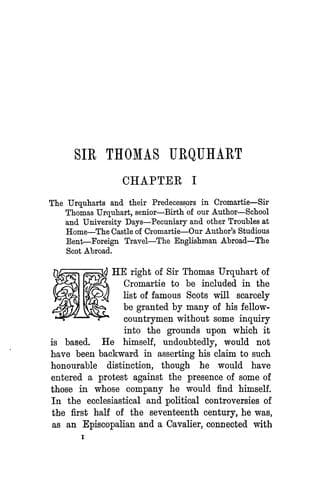
prescribed series, were permitted to reply, or commence new motions on
any subject, in what language soever, and howsoever expressed; to all
which, he being bound to tender himself a respondent, in matter and form
suitable to the impugners propounding, he did first so transcendently
acquit himself of that circumstantial kinde of oratory, that, by
well-couched periods, and neatly running syllables, in all the twelve
languages, both in verse and prose, he expressed to the life his
courtship [courtliness] and civility; and afterwards, when the Rector of
the university, (unwilling to have any more time bestowed on superficial
rhetorick, or to have that wasted on the fondness of quaint phrases,
which might be better employed in a reciprocacy of discussing
scientifically the nature of substantial things), gave direction to the
professors to fall on, each according to the dignity or precedency of
his faculty, and that conform to the order given. Some metaphysical
notions were set abroach, then mathematical, and of those arithmetical,
geometrical, astronomical, musical, optical, cosmographical,
trigonometrical, statical, and so forth through all the other branches
of the prime and mother sciences thereof; the next bout was through all
natural philosophy, according to Aristotle's method, from the
acroamaticks, going along the speculation of the nature of the heavens,
and that of the generation and corruption of sublinary things, even to
the consideration of the soul and its faculties; in sequel hereof, they
had a hint at chymical extractions, and spoke of the principles of
corporeal and mixed bodies, according to the precepts of that art. After
this, they disputed of medicine, in all its thereapeutick,
pharmacopeutick, and chirurgical parts; and not leaving natural magick
untouched, they had exquisite disceptations concerning the secrets
thereof. From thence they proceeded to moral philosophy, where, debating
of the true enumeration of all vertues and vices, they had most learned
ratiocinations about the chief good of the life of man; and seeing the
[that] œcumenicks and politicks are parts of that philosophy, they
argued learnedly of all the several sorts of governments, with their
defects and advantages; whereupon perpending, that, without an
established law, all the duties of ruling and subjection, to the utter
ruin of humane society, would be as often violated as the irregularity
of passion, seconded with power, should give way thereto. The Sorbonist,
canonical, and civilian doctors most judiciously argued with him about
the most prudential maximes, sentences, ordinances, acts, and statutes
for ordering all manner of persones in their consciences, bodyes,
fortunes, and reputation; nor was there an end put to those literate
exercitations till the grammarians, rhetoricians, poets, and logicians
had assailed him with all the subtleties and nicest quodlibets their
respective habits could afford. Now when, to the admiration of all that
Public-domain text, read in full here on John Shaqi.
Reviews
Reviews
No reviews yet
Be the first to share your thoughts on this work.
Elsewhere in the archive
Join the Discussion
Join the discussion
Sign in to leave a comment or review.
Sign InorCreate an account