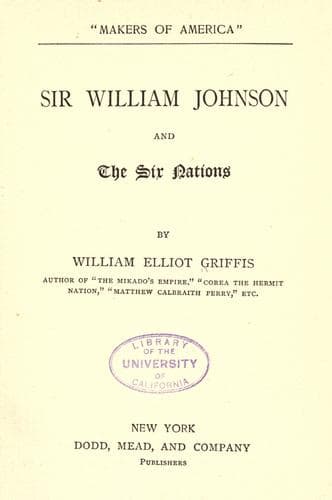
Sir William Johnson and the Six NationsGriffis, William Elliot
History
Sir William Johnson and the Six Nations
Griffis, William Elliot
Johnson, William, 1715-1774; United States -- History -- French and Indian War, 1754-1763
On that very day, as was soon afterward learned, the French were at Fort
Massachusetts,[5] which had been built by Col. Ephraim Williams. It
stood in the meadows east of Williamstown, under the shadow of old
Greylock, beyond the present town of North Adams. After two days’ siege
the brave garrison surrendered and were led away to Canada. The French
lost forty-seven men. The fort was afterward, in 1747, rebuilt, and was
the scene of more than one attack by the enemy.
The council-fire was then raked up, so that the braves might have time
to sleep, smoke, and deliberate for reply. When the council re-opened on
the 24th, the governor was present, and the first orator at the
rekindled fire was an Onondaga chief. After the usual efflorescence of
forest rhetoric, he promised in the name of the Seven Nations—a small
army of eight hundred braves from Detroit and the Lake country, the
Missesagues, having temporarily joined the confederates for the common
purpose—to dig up the hatchet against the French and their allies. They
further agreed to roast alive any French priest who came among them. The
next day was devoted to distributing the presents sent from the king and
the governors of Virginia and Massachusetts; the new tribe, Missesagues,
receiving one fourth. On the 26th the kettle was hung over the fire, and
a great war-dance held, in which, after unusual smearings of paint, the
weird, wild, and guttural, but pathetic songs were sung. After a few
private interviews with the chiefs, and further tickling of their palms
with presents and their stomachs with fire-water, the council-fire was
put out by separation and scattering. Part of the Valley Indians
remained in Albany, in token of their loyalty to the English, while most
of them returned to their castles to organize war-parties. Unfortunately
an epidemic of the small-pox broke out at this time all along the
Valley, carrying off hundreds of the Indians, among whom were the two
delegates from the Missesagues.
Public-domain text, read in full here on John Shaqi.
Reviews
Reviews
No reviews yet
Be the first to share your thoughts on this work.
Join the Discussion
Join the discussion
Sign in to leave a comment or review.
Sign InorCreate an account