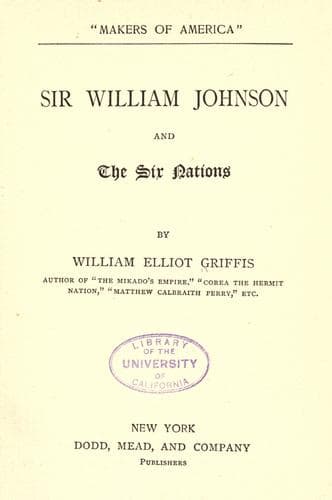
Sir William Johnson and the Six Nations — John Shaqi
Sir William Johnson and the Six NationsGriffis, William Elliot
History
Sir William Johnson and the Six Nations
Griffis, William Elliot
Johnson, William, 1715-1774; United States -- History -- French and Indian War, 1754-1763
Other councils were held with lesser bodies of Indians; and Johnson,
despite the raging of the small-pox among the Valley Indians,
endeavoured to keep the savages on the war-path toward Canada; but
little was accomplished during the summer. While the coming French fleet
was destroyed by storm, Johnson increased his fortune by being appointed
government contractor for Oswego, and his fame by being commissioned by
Clinton as Colonel of militia. The only campaign in 1747 was one of
paper and ink, Shirley and Clinton being the chief combatants. There
were also raids and fights on the New England borders, but little took
place that needs to be chronicled here. Clinton and De Lancey kept up
their quarrels; the former warning Johnson of his illustrious relative,
venting his wrath on the Dutch legislators, and taking high-handed
vengeance on Judge Daniel Horsmanden. This champion of the Assembly and
people, and one of the ablest jurists in the province, was most
obnoxious, politically, to the king’s representatives. He was also
personally offensive as being the co-worker with Chief-Justice De
Lancey.
On the 12th of September Horsmanden was suspended from service as a
member of the council. The fact was published in the journal; but no
reason was given for this, except that the governor announced that he
would explain his action to the king. Horsmanden was also removed from
his other positions,—as commissioner to meet the representatives of the
other colonies, and as judge and recorder of the city. This act of the
governor’s still further irritated the “stubborn Dutchmen,” whose
hostility now turned into a war to the knife. Even though savages were
ravaging the suburbs of New York, it is doubtful whether they would have
been turned from their determination to fight absolutism, in the person
of Clinton. When the governor announced the return of Johnson from his
fruitless search after the enemy at Crown Point, the temper of the
Assembly was not improved. They were tired of having the praises of
Johnson sounded in their ears. They still refused, in the face of
Johnson’s contract, while still in force, to furnish extra guards for
the fulfilment of his stipulation in provisioning Oswego. They also
adhered to their determination not to yield to the governor’s demands,
so long as he thwarted their purposes. In affirming their former
resolutions, they, nevertheless, offered to indemnify Johnson if through
accident he became a loser by fulfilling his contract.
Public-domain text, read in full here on John Shaqi.
Reviews
Reviews
No reviews yet
Be the first to share your thoughts on this work.
Join the Discussion
Join the discussion
Sign in to leave a comment or review.
Sign InorCreate an account