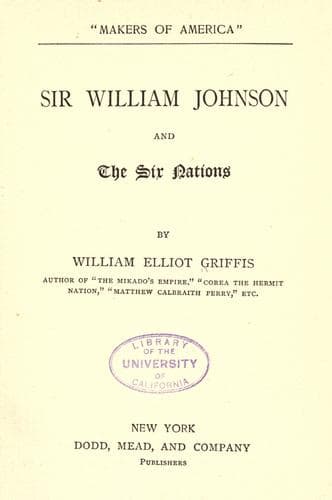
Sir William Johnson and the Six NationsGriffis, William Elliot
History
Sir William Johnson and the Six Nations
Griffis, William Elliot
Johnson, William, 1715-1774; United States -- History -- French and Indian War, 1754-1763
In this last point, especially, the Dutch blood was roused; for although
in monarchical England the power of making treaties is vested in the
sovereign, yet in the Dutch Republic, then a living reality before their
eyes, the States-General, like the United States Senate, shared with the
Stadtholder or President the right of treaty-making, and had the power
of veto upon all compacts. Even in Great Britain, the exercise of the
treaty-making power by the king was subject to parliamentary censure,
and ministers negotiating a disadvantageous treaty were liable to
impeachment. This right had been several times exercised in the
sixteenth and even in the fifteenth century.
The address wound up by this declaration: “No treatment your Excellency
can use toward us, no inconveniences how great soever that we may suffer
in our own persons, shall ever prevail upon us to abandon, or deter us
from steadily preserving the interest of our country.”
A committee waited upon the governor on the 9th of October, to present
the address; but the angry executive would not hear it, nor receive a
copy, and three days later replied with all the artillery of rhetoric
and abuse which he and his secretary were able to load into the
document. It was as full of vituperation as a carronade of later day was
of langrage shot. As to their complaint that the money intended for
Indian presents was not honestly distributed, he charged the House with
telling “as bold a falsehood as ever came from a body of men.” He was in
no way accountable to the Assembly for the manner in which he
distributed the money of the Crown. He charged them with violating both
the civil and military prerogatives of the king. “Nor will I,” he said,
“give up the least branch of it [the military prerogative] on any
consideration, however desirous you may be to have it, or to bear the
whole command.” He also asserted, with some attempt at humour, that
their farce of locking the door and placing the key upon the table—a
symbolic act charging breach of privilege upon the executive—was a high
insult to King George’s authority, and in so far, an act of disloyalty.
He charged that they were assuming the rights and privileges of the
House of Commons, and renouncing their subjection to the Crown and
Parliament. He had his Majesty’s express command not to suffer them to
bring some matters into the House, nor to debate upon them; and he
intimated that he had a right to stop proceedings when they seemed to
him improper or disorderly. After a tirade upon their insolence and
unbecoming conduct, his peroration was a warning not to infringe upon
the royal prerogative.
Public-domain text, read in full here on John Shaqi.
Reviews
Reviews
No reviews yet
Be the first to share your thoughts on this work.
Join the Discussion
Join the discussion
Sign in to leave a comment or review.
Sign InorCreate an account