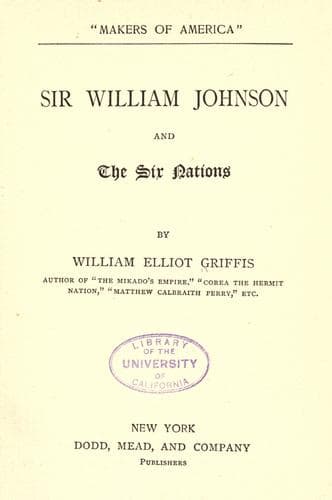
Sir William Johnson and the Six NationsGriffis, William Elliot
History
Sir William Johnson and the Six Nations
Griffis, William Elliot
Johnson, William, 1715-1774; United States -- History -- French and Indian War, 1754-1763
Still the Assemblymen, who thought the Indians ought to have been
allowed to go on their hunting, ought to have been kept friendly, but
not stirred up to fight the French or be sent to Canada, and ought to
have stayed in New York to guard their own old men and squaws instead of
having white men drafted to do it, distrusted the servant of the king
and the tool of Colden, and doubted the fitness of the governor’s
appointees to office. They questioned the wisdom of the governor’s
general policy; and they intimated, with only too good reason, that the
money so freely distributed for the Indians was not properly and
publicly accounted for. They voted promptly all that was necessary for
the expedition against Canada. They fully realized the necessity of
holding firm the loyalty of the Six Nations; and to keep it, they
offered at once to vote the sum of eight hundred pounds, provided the
persons chosen to distribute the people’s money were such as they
approved of. In regard to the forts on the distant frontier, so near
Canada, they considered that the other colonies should share the expense
of permanently guarding the king’s dominions.
In answer to these defiant resolutions, which practically impeached the
governor, Clinton sent a curt and insulting note of less than one
hundred words. The Dutchman’s ire now blazed fiercely. After the
significant ceremony of locking the door and laying the key on the
table, they proceeded to issue a manifesto, marshalling in review the
whole proceedings since June 6, 1746. They censured him for removing the
former commissioners of Indian affairs, and for practically making Dr.
Colden the real administrator of affairs in the cabinet, and Colonel
Johnson in the field. They sneered at the pretensions and vanity of the
governor in his constant boasting of what he claimed to have done. They
charged him with treating the people of the colony with contempt, and
with insulting them by vile epithets. They complained of the many brief
and inconvenient adjournments to which he had needlessly subjected them.
Especially were they enraged in their feelings at the deference paid, at
their expense, to the commissioners from Massachusetts and Connecticut.
They claimed that they ought to have been kept in session, in order that
they might have been advised with, and their opinions consulted from
time to time as to the matters under consideration.
Public-domain text, read in full here on John Shaqi.
Reviews
Reviews
No reviews yet
Be the first to share your thoughts on this work.
Join the Discussion
Join the discussion
Sign in to leave a comment or review.
Sign InorCreate an account