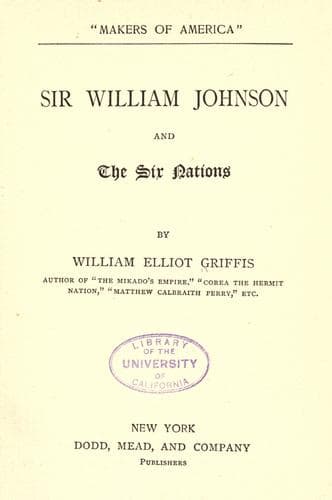
Sir William Johnson and the Six NationsGriffis, William Elliot
History
Sir William Johnson and the Six Nations
Griffis, William Elliot
Johnson, William, 1715-1774; United States -- History -- French and Indian War, 1754-1763
It was, indeed, true that New York was setting what was in the eyes of
the Tories a most dangerous example to her neighbours. Most of the
people of this colony were descendants of those who had come from the
Dutch Republic, where the taxation without consent had been resisted for
centuries, and where resistance to monarchy and feudal ideas had been
exalted into a principle. It was this determined spirit, reinforced by
the lovers of liberty, whether of Huguenot, Irish, Scottish, or Welsh
blood, or men from the mother country who believed that the rights of
Englishmen were still theirs, that made New York lead all the thirteen
original colonies in outgrowing the colonial spirit. New Yorkers first
took the steps which must logically and actually lead to separation from
the transatlantic country, whose language was indeed spoken in America,
but by colonists who had continued the institutions not of monarchical
England, but of republican Holland.
-----
[5] I visited the site of Fort Massachusetts, March 12, 1891. Though
long ago levelled by the plough, the spot has been marked by Prof.
Arthur Latham Perry, of Williams College, who planted the handsome
elm-tree which now flourishes there. The sword, watch, and many other
interesting relics of Colonel Williams, moulded or rusted, from Fort
Massachusetts, from the battle-grounds of Lake George, Bloody Pond, and
other places famous in colonial warfare, are carefully preserved in the
college cabinet. A monument with the names of the garrison should mark
the site of Fort Massachusetts.
CHAPTER VI.
A TYPICAL FRONTIER FIGHT WITH INDIANS.
TO REORGANIZE the demoralized militia of the northern counties, Governor
Clinton in November offered the command of the entire frontier to
Johnson, who after due consideration accepted. Besides having the
confidence of the people, among whom he was personally popular, Johnson,
being backed by the Executive Council, was able to do the work expected
of him, and bring about much needed reform, especially in improving the
quality of the officers and the general discipline. The able-bodied men
of the Mohawk Valley, mostly Dutch and German, with a few English,
Irish, and Scots, were organized into nine companies of militia. Each
village or settlement had its company of one hundred men, the most
westward being at German Flats. Schenectady had two companies, and at
Albany there were several; while all the farmers living in the open
country, between forts or palisaded villages, were likewise enrolled.
Public-domain text, read in full here on John Shaqi.
Reviews
Reviews
No reviews yet
Be the first to share your thoughts on this work.
Elsewhere in the archive
Join the Discussion
Join the discussion
Sign in to leave a comment or review.
Sign InorCreate an account