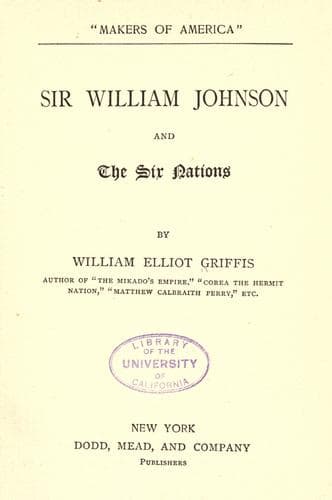
Sir William Johnson and the Six NationsGriffis, William Elliot
History
Sir William Johnson and the Six Nations
Griffis, William Elliot
Johnson, William, 1715-1774; United States -- History -- French and Indian War, 1754-1763
Johnson’s wealth as farmer, fur-trader, army-contractor, and salaried
officer was now steadily increasing. Even the victualling of Oswego
ceased to be a losing enterprise, since the Assembly, in February, 1748,
voted two hundred pounds to reimburse him for the extraordinary charges
to which he had been put. The same Assembly, however, voted one hundred
and fifty pounds to Mr. Horsmanden, whom Clinton had arbitrarily deposed
from the Council, and also appointed an agent to reside in London to
represent them and act with them and for the people against the
governor. In this the Dutch legislators were following a precedent which
their fathers had established, in having agents to represent them to the
States-General in Holland, and which they continued under English rule,
when they sent Peter Stuyvesant to the Court of King Charles II. in
1667.
The expedition to Canada being wholly given up, it was necessary to
conciliate the Indians with presents. In April, Johnson set out to
Onondaga, the central council-fire of the Iroquois Confederacy, to meet
the delegates of all the tribes, in order to ascertain their temper and
invite them to a great council at Albany. His other purposes in going
were to circumvent the schemes of Joncaire the French Jesuit, and talk
the Indians into giving their permission to have forts erected in their
country. As usual, he was not too squeamish in the use of means to
accomplish his purpose. He wrote from Albany, April 9, 1748, to Captain
Catherwood: “I shall leave no stone unturned to accomplish what I go at,
either by fair or foul means; for if they are obstinate—I mean the
Onondagas—I shall certainly talk very harsh with them, and try what
that will do.”
Leaving Mount Johnson with a guard of fifty men, with Captain Thomas
Butler and Lieutenant Laurie as officers, he set off, in bateaux heavily
laden with presents and provisions, up the Mohawk. To move these loaded
boats against the current, by punting, pushing, pulling, sailing, or
floating their way along, was slow work, but was safely accomplished.
Some of the Indians had come with pleasant remembrances of the courtesy
of Mount Johnson. They felt deeply that sort of gratitude which has been
defined as a “lively sense of favours to come.” Having arrived some days
before, and waited with attenuated rations, they were ravenous when
Johnson and his stores arrived on April 24. After a salute of fire-arms
and the unfurling of a British flag, three bark houses were assigned to
the company, while Johnson was escorted to a large new lodge in which
the mats were fresh and clean. That night a feast was given to the
Indians out of the stores brought, all business being deferred until
next day.
Public-domain text, read in full here on John Shaqi.
Reviews
Reviews
No reviews yet
Be the first to share your thoughts on this work.
Elsewhere in the archive
Join the Discussion
Join the discussion
Sign in to leave a comment or review.
Sign InorCreate an account