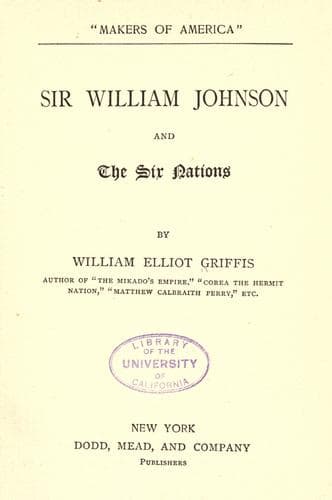
Sir William Johnson and the Six NationsGriffis, William Elliot
History
Sir William Johnson and the Six Nations
Griffis, William Elliot
Johnson, William, 1715-1774; United States -- History -- French and Indian War, 1754-1763
Brave as were the Americans behind the rude barricade, they did not
excel the French regulars, who fought until they were nearly
annihilated. It was well into the afternoon when they were deserted by
hundreds of French forest-rangers and Canadian Indians, who, seeing no
hope of winning the day, skulked away to the scene of the morning’s
ambuscade,—the one set to plunder, and the other to scalp the slain.
About four o’clock so many of the white-coated regulars were prone on
the ground and so few in action, all their officers being disabled,
while the fire of the others had slackened, that the Americans began to
get out of their breastworks, and to fight in the woods. This made the
French give way so visibly that the whole of Lyman’s force rushed out on
the enemy with their hatchets and clubbed muskets, pushing them out of
ambush into full retreat. This onset took place between four and five
o’clock P. M., and resulted in completely driving the enemy off the
field.
The fighting was not yet over, for the third battle on this eventful day
was yet to take place. Hearing the distant firing, Colonel Blanchard, of
Fort Lyman, sent out a party of two hundred and fifty men under command
of the brave Captain McGinnis, who, with his Schenectady men, led the
van. Warily approaching the place of the morning’s ambuscade, with
scouts ahead, they succeeded in getting between the piled-up baggage of
the French army and a vidette of five or six men who were keeping a
lookout on a hill. Moving farther up the road, they found a party of
three hundred French and Indians, consisting of those who had plundered
the slain, and of other remnants of the beaten army, who were eating
cold rations out of their packs. They sat along Rocky Brook and the
marshy pond. McGinnis and his men approached stealthily until within
firing distance, and then, after a volley, charged like tigers upon
their prey.
In the fight which ensued the Americans contested against heavy odds;
but although their brave captain was mortally wounded, he directed their
movements till the firing ceased, and the third battle of this eventful
day resulted in victory. Not till the next evening did the scattered
band of Dieskau’s army meet, exhausted and famished, at the place where
they had left their canoes.
Public-domain text, read in full here on John Shaqi.
Reviews
Reviews
No reviews yet
Be the first to share your thoughts on this work.
Elsewhere in the archive
Join the Discussion
Join the discussion
Sign in to leave a comment or review.
Sign InorCreate an account