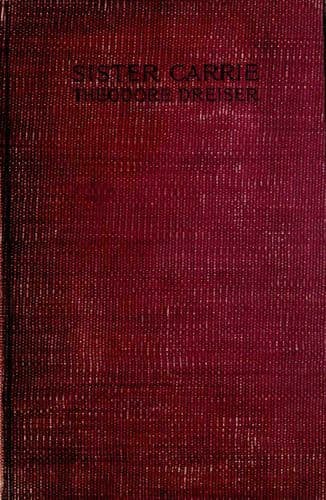
Chicago (Ill.) -- Fiction; Didactic fiction; Mistresses -- Fiction; New York (N.Y.) -- Fiction; Young women -- Fiction
When Carrie reached her own room she had already fallen a prey to those
doubts and misgivings which are ever the result of a lack of decision.
She could not persuade herself as to the advisability of her promise, or
that now, having given her word, she ought to keep it. She went over the
whole ground in Hurstwood's absence, and discovered little objections
that had not occurred to her in the warmth of the manager's argument.
She saw where she had put herself in a peculiar light, namely, that of
agreeing to marry when she was already supposedly married. She
remembered a few things Drouet had done, and now that it came to walking
away from him without a word, she felt as if she were doing wrong. Now,
she was comfortably situated, and to one who is more or less afraid of
the world, this is an urgent matter, and one which puts up strange,
uncanny arguments. "You do not know what will come. There are miserable
things outside. People go a-begging. Women are wretched. You never can
tell what will happen. Remember the time you were hungry. Stick to what
you have."
Curiously, for all her leaning towards Hurstwood, he had not taken a
firm hold on her understanding. She was listening, smiling, approving,
and yet not finally agreeing. This was due to a lack of power on his
part, a lack of that majesty of passion that sweeps the mind from its
seat, fuses and melts all arguments and theories into a tangled mass,
and destroys for the time being the reasoning power. This majesty of
passion is possessed by nearly every man once in his life, but it is
usually an attribute of youth and conduces to the first successful
mating.
Hurstwood, being an older man, could scarcely be said to retain the fire
of youth, though he did possess a passion warm and unreasoning. It was
strong enough to induce the leaning toward him which, on Carrie's part,
we have seen. She might have been said to be imagining herself in love,
when she was not. Women frequently do this. It flows from the fact that
in each exists a bias toward affection, a craving for the pleasure of
being loved. The longing to be shielded, bettered, sympathised with, is
one of the attributes of the sex. This, coupled with sentiment and a
natural tendency to emotion, often makes refusing difficult. It
persuades them that they are in love.
Public-domain text, read in full here on John Shaqi.
Reviews
Reviews
No reviews yet
Be the first to share your thoughts on this work.
Elsewhere in the archive
Join the Discussion
Join the discussion
Sign in to leave a comment or review.
Sign InorCreate an account