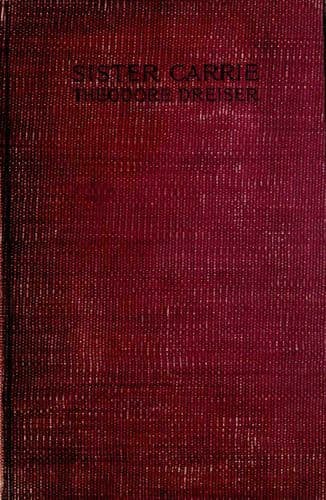
Chicago (Ill.) -- Fiction; Didactic fiction; Mistresses -- Fiction; New York (N.Y.) -- Fiction; Young women -- Fiction
On her spiritual side, also, she was rich in feeling, as such a nature
well might be. Sorrow in her was aroused by many a spectacle--an
uncritical upwelling of grief for the weak and the helpless. She was
constantly pained by the sight of the white-faced, ragged men who
slopped desperately by her in a sort of wretched mental stupor. The
poorly clad girls who went blowing by her window evenings, hurrying home
from some of the shops of the West Side, she pitied from the depths of
her heart. She would stand and bite her lips as they passed, shaking her
little head and wondering. They had so little, she thought. It was so
sad to be ragged and poor. The hang of faded clothes pained her eyes.
"And they have to work so hard!" was her only comment.
On the street sometimes she would see men working--Irishmen with picks,
coal-heavers with great loads to shovel, Americans busy about some work
which was a mere matter of strength--and they touched her fancy. Toil,
now that she was free of it, seemed even a more desolate thing than when
she was part of it. She saw it through a mist of fancy--a pale, sombre
half-light, which was the essence of poetic feeling. Her old father, in
his flour-dusted miller's suit, sometimes returned to her in memory,
revived by a face in a window. A shoemaker pegging at his last, a
blastman seen through a narrow window in some basement where iron was
being melted, a bench-worker seen high aloft in some window, his coat
off, his sleeves rolled up; these took her back in fancy to the details
of the mill. She felt, though she seldom expressed them, sad thoughts
upon this score. Her sympathies were ever with that under-world of toil
from which she had so recently sprung, and which she best understood.
Though Hurstwood did not know it, he was dealing with one whose feelings
were as tender and as delicate as this. He did not know, but it was this
in her, after all, which attracted him. He never attempted to analyse
the nature of his affection. It was sufficient that there was
tenderness in her eye, weakness in her manner, good-nature and hope in
her thoughts. He drew near this lily, which had sucked its waxen beauty
and perfume from below a depth of waters which he had never penetrated,
and out of ooze and mould which he could not understand. He drew near
because it was waxen and fresh. It lightened his feelings for him. It
made the morning worth while.
In a material way, she was considerably improved. Her awkwardness had
all but passed, leaving, if anything, a quaint residue which was as
pleasing as perfect grace. Her little shoes now fitted her smartly and
had high heels. She had learned much about laces and those little
neck-pieces which add so much to a woman's appearance. Her form had
filled out until it was admirably plump and well-rounded.
Hurstwood wrote her one morning, asking her to meet him in Jefferson
Park, Monroe Street. He did not consider it policy to call any more,
even when Drouet was at home.
Public-domain text, read in full here on John Shaqi.
Reviews
Reviews
No reviews yet
Be the first to share your thoughts on this work.
Elsewhere in the archive
Join the Discussion
Join the discussion
Sign in to leave a comment or review.
Sign InorCreate an account