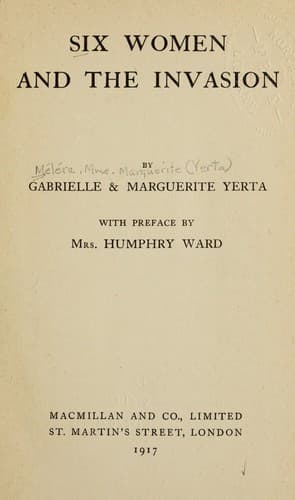
Six Women and the InvasionMéléra, Marguerite-Yerta
History
Six Women and the Invasion
Méléra, Marguerite-Yerta
World War, 1914-1918 -- Personal narratives
One of his men drew the moral of this discourse by aiming his gun at us.
"Franzouss ... all shot."
They stayed two hours, strolling about the yard, muttering insults
between their teeth. To complete our misfortune, the convoy spent the
night in Morny. The men came back in the evening, and the commandant
being away they made the most fearful row we had ever heard, from nine
to eleven, and yet the Hussars were not bad at rough music.
They were not bad at many other jobs. They were acknowledged the most
skilful hunters of hiding-places, and Sainte-Brute, with his acolytes,
spent many a day in wandering through fields and gardens. They sought
for holes that might conceal potatoes, corn, or--generally near to the
houses--wine which they were so fond of. The Conventions of the Hague,
it would seem, allow the invaders of a country to requisition wine, for
the use of the "wounded"; so when the soldiers emptied a cellar or
discovered a _cache_ they declared with gravity that it was all for the
Red Cross. I suppose the Germans bear a likeness to zoophytes, what one
of them absorbs is profitable to the others, and when wine had been
unearthed "for the wounded" the whole pack were drunk for days together.
And these creatures took all--all. They destroyed systematically what
they could not take away. After having despoiled us of our money, they
seized corn, straw, vegetables, wine, milk, eggs. Poultry, cows, oxen,
the very horses which the peasants had bought of them in a bad
condition, and taken good care of, belonged to them, and they alone were
entitled to dispose of them. All that was on the earth and beneath the
earth, all that was growing and living--including the people--were their
own property. They carried off the very paving-stones heaped up on the
wayside to repair the roads. If they stay long enough they will carry
away, cart after cart, the rich, fat earth of our soil, to spread over
and fertilise the barren ground of Prussia. If they could find a means,
with the help of their alchemists who have made a pact with the devil,
they would take away our deep-blue sky in panels; they would drag along
our bracing and mild air to purify the mists of the north.
As they cannot--despite their bargain with the devil--perform such feats
of skill, they wreak revenge on us by spoiling our beautiful country.
Our farmers were furious when they saw the Germans--the first winter
after their arrival--plough up fields throughout the land, unmindful of
the limits and value of the soil. And what splendid tillage was theirs!
Their laziness turned up about ten centimetres of earth; they sowed
seed, and put no manure; before they leave they want to exhaust the soil
of which they are jealous, and which they would like to annihilate. They
cut down nut trees to make butt-ends of guns, and fruit trees to amuse
themselves.
Public-domain text, read in full here on John Shaqi.
Reviews
Reviews
No reviews yet
Be the first to share your thoughts on this work.
Elsewhere in the archive
Join the Discussion
Join the discussion
Sign in to leave a comment or review.
Sign InorCreate an account