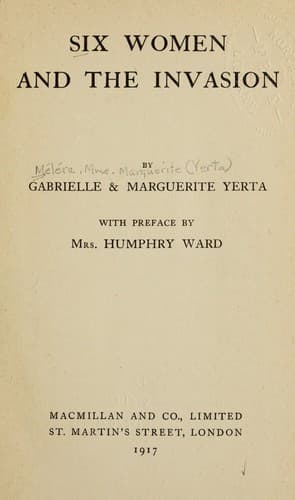
Six Women and the InvasionMéléra, Marguerite-Yerta
History
Six Women and the Invasion
Méléra, Marguerite-Yerta
World War, 1914-1918 -- Personal narratives
To be sure one would go mad for less. Our life was duller than any
one's: fancy six women shut up in a house, having nothing particular to
do, always engrossed by the same tiring thoughts. Leisure is an evil
very difficult to bear in an invaded territory. You wait; you do nothing
else; you seem to be in a condition that cannot go on for long. Work? To
what purpose? For whose sake? And what work to do? Save the men whom the
Germans have requisitioned, and who, of course, tire themselves as
little as possible, every one drags out his days. The baker, the
teachers, and the cobbler are the only persons of the village really
busy. We envied them their occupations, as we had but our needles to
fill up our free hours. Very soon we had darned our old clothes, set
them to rights, and distributed them among the poor. There was a family
of seven children, whose mother had just died, and whose clothes we kept
in decent condition. But it was not enough. We, too, yawned our life
away.
Ten times a day we cried aloud for the means of escape! Escape! To live
again an active life, to see people who are not Germans, to know what is
going on, to live!
A gleam of hope came: it was in the month of March, the garden was
already strewn with snowdrops, primroses, and crocuses. Captivity was
harder to bear than ever. One day the rural constable made an
announcement. He appeared to our eyes crowned with a golden nimbus, and
more dazzling than an archangel; his voice was sweeter than honey. He
said:
"The persons who want to leave the invaded territory to go into other
parts of France may have their names put down at the townhall with the
exception of the men from fourteen to sixty."
This caused so great an emotion among us that we well-nigh quitted this
life suddenly and simultaneously. We kept on the look-out for Bubenpech,
when he should come home, to demand further particulars.
This Bubenpech did not please us at all. It is agreed that no Prussian
could have pleased us. But on the dislike we entertain to the whole race
was grafted a personal aversion to him. He was dark-haired,
middle-sized, short-legged, with a solid torso, topped by a big neckless
head. He had regular features, deceitful eyes, and looked something of a
rake. He was said to be nearly related to a general, and he thought
himself irresistible.
"How dissipated he looks," we said the first time we saw him.
And one of his soldiers whispered in Mme. Lantois' ear:
"Lieutenant, not bad! ... but many women, many women. That's not good!"
In fact Bubenpech led a most dissolute life. He soon brought confusion
upon Morny, and his stay there was the commencement of a debauch that
caused a scandal throughout the region.
With us he was at first all smiles. But our looks soon chilled him, and
he was content with a short bow when he happened to meet one of us,
which was rare, for we carefully avoided him.
Public-domain text, read in full here on John Shaqi.
Reviews
Reviews
No reviews yet
Be the first to share your thoughts on this work.
Elsewhere in the archive
Join the Discussion
Join the discussion
Sign in to leave a comment or review.
Sign InorCreate an account