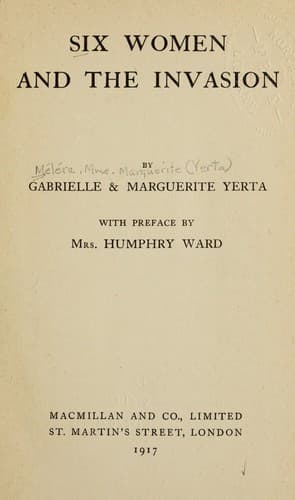
Six Women and the InvasionMéléra, Marguerite-Yerta
History
Six Women and the Invasion
Méléra, Marguerite-Yerta
World War, 1914-1918 -- Personal narratives
A few women with their children and a cripple ran away, thinking they
might reach their village. They were overtaken, some at five, others at
ten kilometres from Jouville, were thrown into prisons without any
further formality, and sentenced to wait there for the departure in
which every one had ceased to believe. Two girls did succeed in getting
home, but were likewise caught and brought back. These flights rendered
our supervision stricter than ever. We had to answer to numberless
roll-calls, and once, when the _Feldwebel_ was in a bad temper, he
called us all "a set of pigs!"
Our misery was alleviated at last, when the American-Spanish Relief
Commission began its work. Jouville had already received some white
flour. The mayor of the village interposed to obtain the same favour for
the emigrants. He succeeded, and the last week of their quarantine the
poor people got bread--white bread. The first day we went to the baker
we saw a stirring sight. The children gazed in wonder at the golden
loaves; they squeezed, they smelt their portion with joy, and without
waiting broke off pieces which they ate eagerly. I saw women look at
their share with staring eyes, and say weeping:
"Bread, real bread!"
This happened the last week of our sojourn in Jouville. Indeed the
longed-for event was about to take place. There were endless reviews and
verifications of names and civil conditions. The men were examined, and
re-examined by the doctor, for all would not be allowed to leave. A card
with a number was delivered to every person, and we were all ordered to
meet in the yard of the sugar-mill at eight o'clock in the morning on
Friday, the 14th of May. Different sentiments prevailed. A few were
overjoyed at the news; others showed signs of despairing incredulity.
"God knows where they are going to take us now! What will become of us?
You will see they will shut us up in Germany!"
But most of them suspended their judgment. Not daring to hope, they
anxiously waited upon events. A still greater misfortune than we had
borne lay in store for us, Geneviève had caught a severe cold about a
month before, and the day we heard delivery was near she was in bed,
shaking with fever. She spent a very bad night, notwithstanding our
care. In the morning I ran for the German doctor--as there was no
other--despite the patient's protests.
"No, no, I will have no Germans about me. Besides, there is nothing the
matter that will prevent me from going."
The fair-haired coxcomb gave a listless ear to my words, looked at me
between his eyelids, and asked with his lips:
"Why did not this person come round for medical advice?"
I replied that "this person" was in a high fever, and could not get up.
Fortunately another doctor had come to help the former to examine the
people before they were allowed to depart. He was a fat, red-faced,
jovial fellow, who showed great haste to oblige me, and repeated over
and over again as he accompanied me:
"Ah! le kerre! pien ture, pien ture!"
Public-domain text, read in full here on John Shaqi.
Reviews
Reviews
No reviews yet
Be the first to share your thoughts on this work.
Elsewhere in the archive
Join the Discussion
Join the discussion
Sign in to leave a comment or review.
Sign InorCreate an account