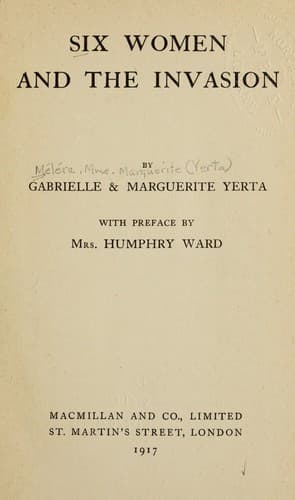
Six Women and the InvasionMéléra, Marguerite-Yerta
History
Six Women and the Invasion
Méléra, Marguerite-Yerta
World War, 1914-1918 -- Personal narratives
Old Mme. Noreau and her grand-daughters faltered some words of sympathy,
Antoinette strove hard to restrain her tears, and Pierrot dared not show
his joy. I went with them as far as the end of the village, where two
gendarmes were busy counting up the herd. I was not allowed to go any
farther, and I stood there gazing at the trampling crowd, and until I
saw them disappear at a winding of the road.
A halting-place had been arranged four miles from thence, where a train
was waiting to convey the emigrants to Hirson. They spent the night in
the waiting-rooms, lying on the floor, sitting on benches, all squeezed
together with fluttering hearts and anxious looks, disturbed by the
squalling of the children and the groans of the old people. In the
morning, the poor wretches were carefully searched, and then crowded
into the train. Two days after they reached France. With tears and cries
of joy they greeted life, at length recovered after so many trials.
CHAPTER XII
After eight months' hopeless waiting, after long weeks spent in a
flutter of expectation, we had seen the gate of delivery closed upon us.
The others were gone; they were free; and Geneviève and I alone still
bore the yoke of invasion, which no one loathed as much as we did. No
one had more eagerly wished for freedom, longed to return home, and
yearned to meet again those we loved, and alone we stayed behind.
The poor girl thought that she would die of despair rather than of
illness, and while she moistened her pillow with tears, I hid my sobs in
the attic.
Mme. Charvet took care of Geneviève, and did her best to comfort us
both. We did not follow the prescriptions of the German doctor, and
never once applied cold compresses. A French matron's experience is at
times worth more than the learning of a Teutonic physician. We applied
mustard-poultices and cupping-glasses; we gave the patient hot
_tisanes_ and syrups, which were all the better because they were made
in the village.
On the 4th of June, three weeks after the convoy's departure, we arrived
at Morny station, in the care of a sergeant. My sister-in-law was still
a convalescent, and we trudged along to the Bureau, where our guardian
handed over his prisoners. Thus we were restored to liberty; we were no
longer emigrants. And with beating hearts we went back home.
On seeing us, my mother-in-law, Yvonne, and Colette well-nigh turned
into stone. They thought we had been in Paris for two months at least.
We returned to our old habits; five women were again under the same
roof, five women in the midst of invasion. One only had succeeded in
escaping.
No change for the better in the village. A single detail amused us. The
soldiers of the line lived as before in a white house at the corner of
the street. For a long time, one of its stout occupants, perched on a
ladder, taking great pains and putting out his tongue, had formulated
this wish in big black letters:
"God punish England!"
Public-domain text, read in full here on John Shaqi.
Reviews
Reviews
No reviews yet
Be the first to share your thoughts on this work.
Elsewhere in the archive
Join the Discussion
Join the discussion
Sign in to leave a comment or review.
Sign InorCreate an account