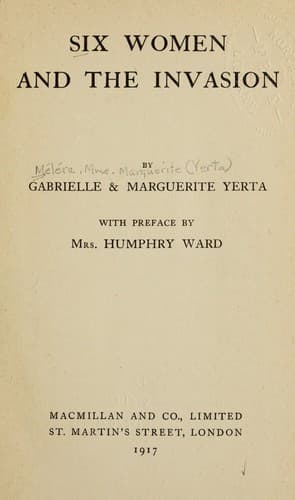
Six Women and the InvasionMéléra, Marguerite-Yerta
History
Six Women and the Invasion
Méléra, Marguerite-Yerta
World War, 1914-1918 -- Personal narratives
I should never finish telling the high deeds of those scoundrels, and I
have still to sing the praises of the revellers. They were many in
number, and I think more dangerous than the rest. They came to France,
allured by the depravity they attributed to us, and it was they who
brought to us their vices, particularly those exclusive to their race,
on which I had rather not insist. No doubt they thought that they would
do a pious work in helping to pervert a country which they hated. Be
that as it may, they eagerly exerted themselves to this end, and did
their best to transform the country behind the front into a vast
brothel. Of course such creatures had not the least respect for the
house which sheltered them. An old lady in Morny was deeply shocked at
being forced to provide two fast girls of Laon with lodging and board
for some days, and many a country house, which had never looked upon
other than peaceful scenes, was scared at revels, the noise of which
made the very window-panes tremble.
Bubenpech was a remarkably vicious specimen. A bottle of champagne was
never emptied in the province without his presence. He was at every
feast, he took part in every rejoicing; he rarely came home before two
or three o'clock in the morning. He had a pretty taste in wine and nice
dinners. Besides, he looked upon himself as Don Juan, and expected every
one to yield to him. No thought hindered his caprices. One day he asked
a young girl publicly to come and see him in his rooms. Another day we
saw him towards dusk kiss two loose girls in the open street. To be at
perfect liberty, he sent to prison, under some pretence or another, a
man whose daughter he was paying court to. He inscribed, among the women
inspected by the police, the name of a young girl who, though not very
respectable, had done no harm but reject his advances. With real Gallic
humour our good villagers were careful to catalogue the great deeds of
our guests, chiefly when heroines from the other side of the Rhine came
upon the scene.
One Sunday morning, about ten o'clock, there appeared at our house a
little German nurse of the Red Cross, dark-haired, smart, and--a fact
hardly to be believed--pretty; but the lady had a peevish air--an air
only.
"Lieutenant Bubenpech?"
"Out."
With all possible speed the orderly went to fetch the officer. Bubenpech
came back as fast as he could, shut himself up with the little dame, and
did not move until four o'clock in the afternoon, forgetful of his
lunch. And the orderly, who timidly presented himself for duty, was
roughly sent away from the closed door.
"Oh," said Mme. Valaine, shocked, "such impudence! in my house!"
The neighbours made jokes and watched the door. They even laid wagers:
they will come out; they won't. At last the couple came out, and
disappeared on foot towards Laon.
A moment after a murmur was heard:
"What does it mean?"
Public-domain text, read in full here on John Shaqi.
Reviews
Reviews
No reviews yet
Be the first to share your thoughts on this work.
Elsewhere in the archive
Join the Discussion
Join the discussion
Sign in to leave a comment or review.
Sign InorCreate an account