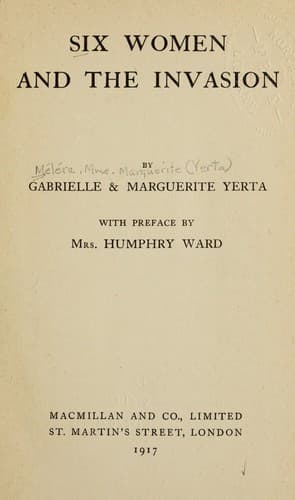
Six Women and the InvasionMéléra, Marguerite-Yerta
History
Six Women and the Invasion
Méléra, Marguerite-Yerta
World War, 1914-1918 -- Personal narratives
But the systematic brutalities, the collective assaults, which marked
the beginning, were no longer known. The method had changed. There were
acts of violence which were no less terrible for being moral. In many a
village whose inhabitants suffered hunger, the children were provided
with bread and soup. Yes, but this privilege was reserved for the
children whose mothers showed themselves complaisant towards the
soldiers. And these women accepted dishonour, because they could not
bear to see their little ones pine away and die, while others could not
withstand the troubles and vexations that lay in store for good women.
A cry of reprobation and horror arose when we heard that the conduct of
all women was not blameless. In the first place there were the women of
the lowest class. Even Boule de suif herself would have been tamed after
daily relations with the German soldiers. Of course a few black sheep
are a disgrace to the flock, and I can fancy women-haters shrugging
their shoulders in scorn when they hear of this.
Gently, sir--a truce to jeering. More than one person wearing a beard
gave abundant proof of an equal complaisance. Alas, traitors were to be
found among us. For instance, there were those who welcomed the Germans
with a smile, and revealed to them the resources of the place. There
were those, the foulest of all, who denounced French soldiers hidden in
the woods or those who fed the fugitives. There were those who, for a
little money or food, pointed out the hiding-places of his neighbours,
and thus surrendered to the enemy wine, grain, potatoes, even money and
jewels. But I am pleased to say that such despicable wretches were rare,
and on the whole the population was proud and dignified, and opposed to
the invaders' dishonesty a solid brotherhood, which no troubles, no
persecutions could lessen or fatigue. And yet we led a grievous life;
the Germans seemed to aim at making it as hard as possible, while theirs
was as merry as can be.
The winter had been painful, but the summer was still more so. We had
less liberty and less food. We were allowed to leave the place we lived
in but three times a week, and on stated days. Besides, we had to ask
for a pass two days beforehand, and pay seventy-five centimes for it
when it was granted, which was not always the case. It was almost
impossible to go to the country from Laon, and for weeks together nobody
was allowed to leave the town. One day passports had been freely given
to the people, tradesmen mostly who went to Marle to buy raw sugar--a
yellowish sticky substance with a taste of glue--and a little butter,
precious goods that were still to be found there in small quantities.
They all came back furious. At different points of the road,
level-crossings, outskirts of villages, they had all been arrested.
Public-domain text, read in full here on John Shaqi.
Reviews
Reviews
No reviews yet
Be the first to share your thoughts on this work.
Elsewhere in the archive
Join the Discussion
Join the discussion
Sign in to leave a comment or review.
Sign InorCreate an account