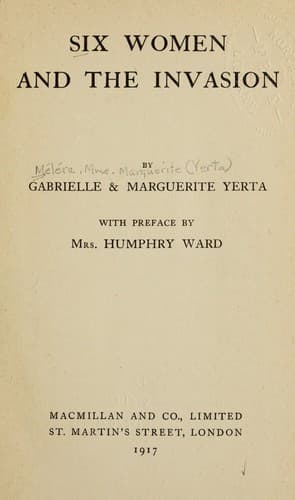
Six Women and the InvasionMéléra, Marguerite-Yerta
History
Six Women and the Invasion
Méléra, Marguerite-Yerta
World War, 1914-1918 -- Personal narratives
When the Germans laugh, it is always a peal. As to tears, they trickle
down their cheeks for a trifle; they bathe in them, they pour them forth
everywhere. I had always looked upon this lachrymal faculty so often
spoken of as a legend, but we have come to the conclusion that there is
nothing more real.
An untoward event, a deception, bad news, or simply home-sickness and
melancholy--anything is an excuse for tears. Here is a famous example.
Those who have visited the battlefields of Mars-la-Tour and Gravelotte
have seen the famous monument--a granite armchair in the midst of a
lawn, surrounded with a balustrade. This noble simplicity should speak
to the soul of itself. Yet an inscription explains:
"During the battle of Mars-la-Tour, the Emperor Wilhelm the First sat
here and wept."
Of course he thought the game was lost. But if his descendants are
faithful to tradition, where will they get the torrents of tears they
will have to shed within a short time!
However, we are not always crying. We even tried to enjoy the summer, to
make up for the sad spring we had spent. As we had to plead a practical
object to obtain leave to take walks out of the village, we begged to be
allowed "to go and fetch wood."
And, lying on the grass in the open country, we tried to forget the war
for a few moments, Geneviève and I, lost in the surrounding calm and
beauty; but distant rumours soon belied our short-lived illusions, and
dispelled the poor creations of the fancy.
No, it was not peace. Our stomachs, always clamouring for food, never
failed to tell us so. During the month of June we hardly ate anything
except asparagus and cherries. These things are not highly nutritious.
No potatoes, a slice of horrid, sticky, sour German bread. Then came
carrots, green peas, and artichokes, and we no longer starved; and when
in the second fortnight of August there arrived the food sent by the
Spanish-American Board of Relief, we thought we had been transported to
a Land of Cockayne. Twenty grammes of bacon daily, a dish of rice on
Sunday, a dish of beans on Thursday, eatable bread; what would you ask
more? No matter. I wonder, when we are once out of this vale of hunger,
how long it will be before we recover our former health.
During the month of July we spent the hot hours of the day out of doors
stretched on the grass. Being near a field of corn, we put out a timid
hand and from time to time broke off ripe ears; we rubbed them between
our fingers, and their plump grains, stripped of the husks, seemed to us
delicious food. It was strictly forbidden to pluck corn, "however small
the quantity might be." "Our leather bags may be searched," we thought,
"but they cannot make a post-mortem examination of us to make sure of a
possible theft." For there is no doubt that we were committing highway
robbery to the prejudice of the Germans.
Public-domain text, read in full here on John Shaqi.
Reviews
Reviews
No reviews yet
Be the first to share your thoughts on this work.
Elsewhere in the archive
Join the Discussion
Join the discussion
Sign in to leave a comment or review.
Sign InorCreate an account