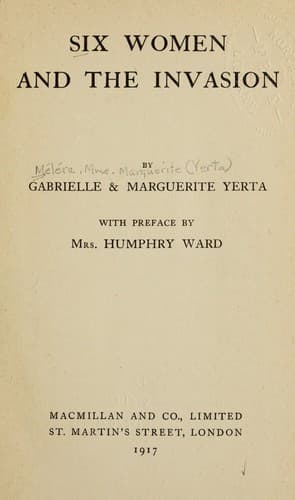
Six Women and the InvasionMéléra, Marguerite-Yerta
History
Six Women and the Invasion
Méléra, Marguerite-Yerta
World War, 1914-1918 -- Personal narratives
Ah, the birds will long remember the summer of 1915!
The harvest lasted three months, and all that time the grain strewed the
ground. Every overripe sheaf lost in transport half its wealth.
"They are but lazy-bones, the whole pack of them," M. Lantois muttered
between his teeth. "When we gather in the harvest, we get up at three
o'clock and work till eight or nine, and we hurry over our meals. But
those fellows! they get up at six, leave off work from eleven to one,
and have done with it at five!"
If the soldiers did not tire themselves out, the civilians they employed
showed no eager haste to do things properly.
The peasants were full of indignation.
"If those idiots had allowed us to gather in the harvest on the
condition that we gave them half or even a third of it, they would have
had more corn than they have now, and we should have been provided for
the whole year!"
However, the Prussians at last understood that more speed was necessary.
And since all the able-bodied men were requisitioned, it was the turn of
the women. The rural constable announced one evening that women who
would work in the fields would receive two francs a day. This aroused a
great deal of wonder. In the times we lived in two francs were looked
upon as a large sum, and many women hired themselves out willingly. A
week after, there was a sudden fall in the tariff. The women heard they
would be paid only fourpence a day, and the female workers dwindled to
zero. The soldiers, in a rage, tried to enlist the women in their very
houses. But they did not succeed. One had a bad headache, another was in
bed, a third was nursing her baby, a fourth was sitting up by her sick
mother, and so on.
This state of things did not last long. The military authorities issued
an order, which enjoined all women from sixteen to fifty to be on the
_place_ of the village at such an hour, to be enrolled as day-labourers.
Mothers of young children alone were exempt. We looked at one another
in bewilderment. Why, then, we had to go too! But if we can wield the
pen and the needle, and on occasion the broom, we are not trained to
handle the sickle, the spade, and the rake. Besides Geneviève was hardly
recovered. Colette is as slender as a reed, and if Yvonne and I are far
from being viragoes in times of peace, we were still weaker after a year
of privation and trouble.
"The little of health and life we have left would be lost in the
fields," said Yvonne.
"I won't risk it," said Geneviève. "I had rather go to prison. Let them
take me to Chalandry!"
It was at Chalandry that the Germans had installed a prison for women.
Jackdaw's Leg good-humouredly reassured us in his most Teutonic accents:
"The measures in hand concern but the peasants," he said.
It is worth while remarking that the officers did their best to be on
tolerable terms with their hosts, and when the inhabitants were
ill-treated, the head of the house was sure to be away.
Public-domain text, read in full here on John Shaqi.
Reviews
Reviews
No reviews yet
Be the first to share your thoughts on this work.
Elsewhere in the archive
Join the Discussion
Join the discussion
Sign in to leave a comment or review.
Sign InorCreate an account