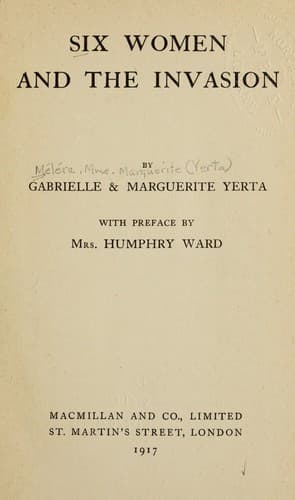
Six Women and the InvasionMéléra, Marguerite-Yerta
History
Six Women and the Invasion
Méléra, Marguerite-Yerta
World War, 1914-1918 -- Personal narratives
More serious was the proclamation which granted a delay to the French
soldiers still in the invaded territory. The blockade had taken a great
many of them by surprise, and had prevented them from reaching the
French line; they wore civil clothes and lived under an assumed name.
Some of them had surrendered at the beginning of the invasion; others
had been discovered and shot. But the new regulation enabled those who
were hidden to give themselves up until the 20th of November. From that
date every French soldier, caught in invaded territory, would be looked
upon as a spy and be immediately shot. As many as eighty surrendered
before the stated day, and oh, desolation! the very day after they
arrested, in a suburb of the town where he lived disguised as a workman,
a French officer, a captain. We read on the bills stuck up in the
streets that he had been shot in the citadel.
Another announcement threatened the villagers more than the town's
people. It intimated that every criminal attempt made at any point of
the railroads would immediately bring terrible reprisals upon the
inhabitants of the neighbouring villages. "Whether guilty or not," the
unhappy wretches would be "driven from their houses if the military
authorities thought proper"; the women would be taken away, and "the men
enrolled in the gangs of labourers." Besides, such hostages as the
Germans selected might be shot.
On the other hand, the invaders were always in readiness to drain the
country of the little money that was left. Many means were at their
disposal. Fines were showered down upon the towns and villages. If a
French aeroplane dropped bombs on the Laon station, the town was quickly
condemned to pay upwards of one hundred thousand francs. In October, to
mark, no doubt, the anniversary of the German occupation, the invaded
were warned that they would have to pay a second contribution of war.
The chief authorities of the communes were told that those under their
charge would soon get into the habit of paying tribute, very likely
every quarter, to the conquerors. "And when all the money has thus been
wrung from all purses, well, you will but have to issue municipal notes,
which you will give to us, the Prussians. So, when the war is at an end,
when you have all been eaten out of house and home, you will all the
same be our debtors!"
Public-domain text, read in full here on John Shaqi.
Reviews
Reviews
No reviews yet
Be the first to share your thoughts on this work.
Elsewhere in the archive
Join the Discussion
Join the discussion
Sign in to leave a comment or review.
Sign InorCreate an account