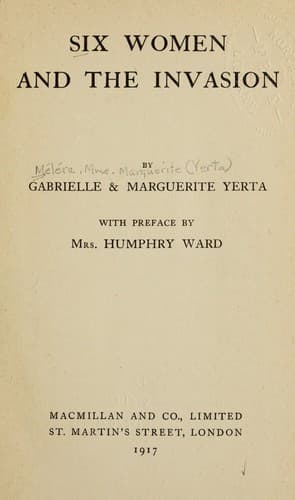
Six Women and the InvasionMéléra, Marguerite-Yerta
History
Six Women and the Invasion
Méléra, Marguerite-Yerta
World War, 1914-1918 -- Personal narratives
"At last the interrogation was at an end. Pierrot's tears were still
falling fast when the officer--a small, dark-haired, Roman-nosed
nervous-looking man, more like a Meridional than a German--allowed
himself to be convinced.
"'Well, I permit you to go on my own responsibility. It was a piece of
good luck you met me here, or you would not have reached your home.
Never go out at nightfall without a passport. Now go.'
"We had but waited for his permission, and were off as soon as it was
given. Pierrot trotted along, still shaken by his sobs.
"'Poor Pierrot, no more crying, it is all over. Take this chocolate. But
you know you are not going to tell tales. You may have one sweet more.
Don't say a word of what you have seen. Mme. Valaine might be worried
about it. Keep these cough lozenges, you will eat them to-morrow.'
"He took the bribe, and, consoled in his mind, promised not to open his
lips about the adventure. So we came back with our heads high, and
without a tremor in our voices."
"You throw off the mask now! You had not relied on the solicitude of the
Germans, who wanted to know if you had come home safely."
In Laon, the Mayor, red and merry, overflowing with fatness and
self-importance, told us simply that the thing was settled, as our
declarations had proved true. He was sorry we had been disturbed to no
purpose. And we too. To walk for three hours at full speed in order to
listen to such rubbish! I shall be believed if I say that ever since
then we never felt inclined to travel without passport, which, besides,
was soon afterwards strictly forbidden. The general regulations were
increased by rules peculiar to every village, differing slightly one
from another according to the local commandant. Those inflicted on Morny
seemed to us the most disagreeable. They saw the light one after the
other. At any time of the day you might meet the rural constable in the
street, his drum by his side, a scrap of paper in his hand. He looked
ashamed of his paltry function, being used by the military authorities
to announce to the world all kinds of nonsense.
"Order to stop all clocks and timepieces in all houses."
Why? Who will ever pierce the mysteries of a German brain?
The kitchens of the farms seemed empty when the pendulums which for ages
had animated the rustic oak clock-cases suddenly stopped, when in the
best bedrooms the shepherds and shepherdesses who adorned the
mantelpieces ceased their tick-tack. Yet in many a room a discreet
murmur survived, and the owner was ever on the look-out ready to stop
the unwonted noise if any search impended. Then came another commandant
who did not care for the order, and little by little the people made
their clocks go as before.
"Order to bring to the _Mairie_--now called Commandature--one lamp out
of every two."
A selection was made, the best lamps were hidden, and the rest given to
the invaders.
"It is forbidden to let dogs and _cats_ go out."
Public-domain text, read in full here on John Shaqi.
Reviews
Reviews
No reviews yet
Be the first to share your thoughts on this work.
Elsewhere in the archive
Join the Discussion
Join the discussion
Sign in to leave a comment or review.
Sign InorCreate an account