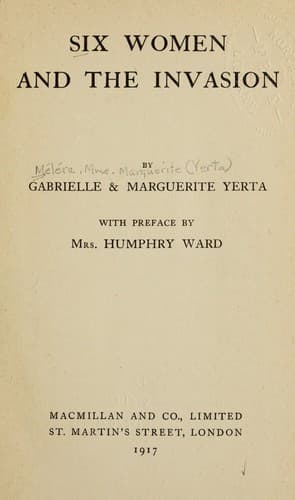
Six Women and the InvasionMéléra, Marguerite-Yerta
History
Six Women and the Invasion
Méléra, Marguerite-Yerta
World War, 1914-1918 -- Personal narratives
We did not require telling twice that it was not worth while. Bought one
at a time, the Prussians were really too expensive. An invaded country
could not afford them at such a price! Then all power of action had been
taken away from us; we could but try to the utmost of our power to save
as much of our goods as possible, to set bounds, with cunning, which is
the arm of the weak, to the ravages of the scourge. If impotent anger
often moved the women into tears, what shall we say of the men? How
shall we depict the fate of thousands of soldiers ordered back home on
the eve of the invasion? They are soldiers, they ought to fight for
their country. They watch from afar the different stages of the battle,
whose manifold din reaches them. They stand, panting, with clenched
fists. They think: "This is going on, such a thing is happening. If I
were with my brothers, I would fall upon the enemy, I would fight
against the invaders."
Their blood is burning; they wish to kill; they will kill some of them.
A sudden uproar, imperious voices are heard. Be quick! Prussians are at
the door. They are shown in, even with a good grace. To refrain so long
from murder, for which they would gladly have paid with their life, more
heroism was required from our men--the natural defenders of molested
women and famished children--than is necessary to rush headlong into the
thickest of a fight.
I have already spoken of the regulations the German authorities had
decreed. But what is impossible to explain, and what people can never
understand who have not lived among the invaders, is the way the laws
were applied, and the thousand vexations that came from them. We were
constantly threatened with requisitions, inquisitions, perquisitions. We
never saw two soldiers walking together in the street without thinking:
"Where are they going? What do they want?"
Among those who were quartered in Morny during October, were a certain
veterinary surgeon, pale-faced and red-haired, and a certain professor,
red-nosed and dark-bearded, both with gold spectacles. The excellent
fellows spoke French as if they had been born in Pontoise, obtruded
themselves everywhere, and took a great interest in everything. They
talked cattle with the farmers, flour with the baker, provisions with
the housewives, and sweets with the urchins. They teased the young
girls, and patted the dogs. After three weeks of such dealings they knew
Morny just as well as the elders of the place, knew your income, your
family affairs and secrets, better than you. They had a large share in
the writing of a guide for the use of the invaders, and when every
inhabitant had been duly analysed, both went away to their pleasant
trade elsewhere. You may guess how useful this was for the Germans, if
you consider what an advantage it would be to leeches to understand
anatomy, and to know the disposition of the blood-vessels.
Public-domain text, read in full here on John Shaqi.
Reviews
Reviews
No reviews yet
Be the first to share your thoughts on this work.
Elsewhere in the archive
Join the Discussion
Join the discussion
Sign in to leave a comment or review.
Sign InorCreate an account