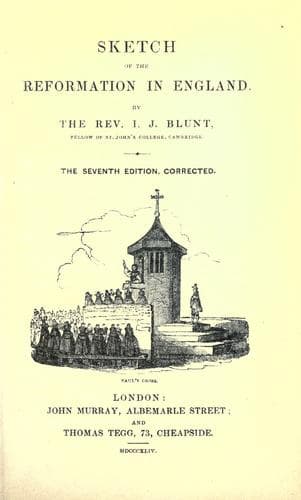
Sketch of the Reformation in EnglandBlunt, John J. (John James)
History
Sketch of the Reformation in England
Blunt, John J. (John James)
Great Britain -- Church history; Reformation -- England
Here again have we to remark and admire the moderation of the
Reformers: they did not unmannerly reject those Offices of the Church
which, however corrupted, lost themselves in a fathomless abyss of
years, and might even have partaken of something of the spirit of an
apostolic age; for though the Clementine liturgy, to which the Missal,
like many other liturgies of various countries and dates, owes many of
its elements, is found in a work, not indeed of the antiquity to which
its title pretends, the Apostolical Constitutions; still it is a work
of very great antiquity, perhaps antecedent to the Council of Nice; and
therefore it is not visionary to suppose that this primitive Office
contained in it breathes the language of very early times indeed, and
that some of the prayers which for three centuries of persecution might
have lived rather by tradition than in writing, may be here more or
less faithfully preserved. These helps which our Reformers did not
disdain, they showed themselves able to improve, correcting what was
objectionable in doctrine, removing what was offensive in taste, and
often communicating by some happy expression even an additional glow
of devotion to passages in themselves (it might have been thought) too
beautiful to touch; for in the whole compass of English literature,
many as are the excellent versions of ancient writings which it can
boast, it would be in vain to look for any specimens of translation
(merely to put the case thus) so vigorous, so simple, so close, and
yet so free from all constraint, as are afforded by the Offices of
our Church. An example taken at random may suffice to acquit us of
all charge of declamation. It shall be one of the Prefaces; that for
Easter. Thus it runs in the Missal:--
“Verè dignum et justum est, æquum et salutare, Te quidem, Domine, omni
tempore, sed in hoc potissimùm gloriosius prædicare, cùm Pascha nostrum
immolatus est Christus. Ipse enim verus est Agnus, qui abstulit peccata
mundi; qui mortem nostram moriendo destruxit, et vitam resurgendo
reparavit. Et ideo cum Angelis et Archangelis, cum Thronis et
Dominationibus, cumque omni militiâ cœlestis exercitûs, hymnum gloriæ
tuæ canimus, sine fine dicentes, Sanctus, Sanctus, Sanctus, Dominus
Deus Sabaoth. Pleni sunt cœli et terra gloriâ tuâ, Hosanna in Excelsis.
Benedictus qui venit in nomine Domini, Hosanna in Excelsis.”
Let any man attempt to express this sublime appeal to God in his
mother-tongue for himself, and then he will know how to appreciate the
ease with which it is effected by those gifted men, to the worth of
whose labours our own generation is not, perhaps, sufficiently alive,
in the following manner:--
Public-domain text, read in full here on John Shaqi.
Reviews
Reviews
No reviews yet
Be the first to share your thoughts on this work.
Elsewhere in the archive
Join the Discussion
Join the discussion
Sign in to leave a comment or review.
Sign InorCreate an account