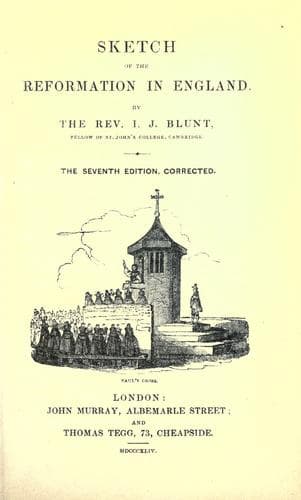
Sketch of the Reformation in EnglandBlunt, John J. (John James)
History
Sketch of the Reformation in England
Blunt, John J. (John James)
Great Britain -- Church history; Reformation -- England
of these foreign theologians, and speak for themselves. Both in the
Confession (and particularly that in the Communion Service) and in the
Absolution, which was taken from Pollanus and not from Calvin, who
did not adopt any form of the kind, extreme expressions with regard
to human depravity to be met with in the originals are studiously
suppressed or qualified in the imitations, as if the morbid anatomy
of our nature was not the theme on which they delighted to dwell,
satisfied with having at least trampled under foot all pretensions of
merit on man’s part, and with having vindicated the _exclusive_
claim of our Lord’s cross and passion to the salvation of a race fallen
at any rate from a pernicious height.[368]
The time of day at which the offices of the Prayer Book, thus
completed, were performed, is not easily determined; and peremptorily
as some have asserted that our morning service for Sundays consists of
three entire services intended for three several hours of prayer, and
extravagantly long, merely owing to this clumsy consolidation of them
all, it would not be easy to prove that such division did ever in fact
obtain. Two services probably are united: the Morning Prayer strictly
so called, being one; the Litany and Communion the other;--but that the
two latter again were ever separated seems very doubtful, or, indeed,
that the first continued for any great while after the Reformation to
be severed from the rest. That such was the case originally there are
many reasons for believing. It naturally succeeded to the _matins_
of the Roman Catholic church, as the Litany and Communion did to the
_High-Mass_;[369] and it would, therefore, be very likely that
the hours in either case would also correspond. Moreover, in all the
early Common Prayer Books, even in the very first, there is a Rubric,
which directs such as intend to partake of the Communion “to signify
their names to the curate over night, or else in the morning before
the beginning of Morning Prayer _or immediately after_;”[370] a
phrase which argues some interval between the two services, such as
might suffice for considering the qualifications of the candidates, and
for providing elements proportioned to the numbers who would attend.
Neither is there wanting some internal evidence of the Morning Prayer
being at first said betimes--“O God, who hast safely brought us to the
_beginning_ of this day, defend us in the same,” being a phrase
scarcely pertinent to any other prayers than orisons.[371] On the
contrary, there are reasons still more satisfactory for thinking that
the Litany was succeeded by the Communion Service without any pause
whatever. In the injunctions of King Edward, put forth in 1547, there
is one to this effect, that “immediately before _High Mass_,
the priests, with other of the quire shall kneel in the midst of the
church, and sing or say plainly and distinctly the _Litany_ which
is set forth in English with the suffrages following.”[372] There is
Public-domain text, read in full here on John Shaqi.
Reviews
Reviews
No reviews yet
Be the first to share your thoughts on this work.
Elsewhere in the archive
Join the Discussion
Join the discussion
Sign in to leave a comment or review.
Sign InorCreate an account