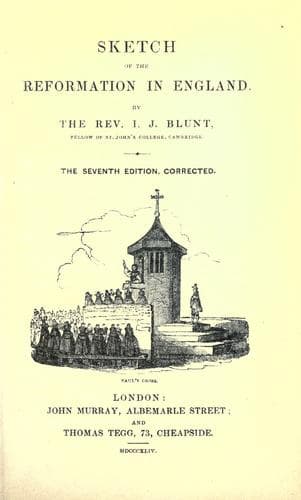
Sketch of the Reformation in EnglandBlunt, John J. (John James)
History
Sketch of the Reformation in England
Blunt, John J. (John James)
Great Britain -- Church history; Reformation -- England
“Farewell, Pembroke Hall, of late mine own college, my care and my
charge! What case thou art now in, God knoweth; I know not well. Thou
wast ever named since I knew thee, which is now thirty years ago, to be
studious, well learned, and a great setter forth of Christ’s Gospel,
and of God’s true word: so I found thee, and, blessed be God, so I
left thee indeed. Woe is me for thee, mine own dear college, if ever
thou suffer thyself by any means to be brought from that trade. In thy
orchard (the walls, buts, and trees, if they could speak, would bear
me witness) I learned without book almost all Paul’s Epistles; yea,
and I ween all the Canonical Epistles, save only the Apocalypse. Of
which study, although in time a great part did depart from me, yet the
sweet smell thereof I trust I shall carry with me into heaven; for the
profit thereof I think I have felt in all my lifetime ever after; and
I ween of late (whether they abide now or no, I cannot tell) there was
that did the like. The Lord grant that this zeal and love toward that
part of God’s word, which is a key and true commentary to all the Holy
Scripture, may ever abide in that college as long as the world shall
endure!”
He then bids farewell to Herne, his parish in Kent, charging himself
with being its debtor for the doctrine of the Lord’s Supper; God not
having at that time revealed it to him.
Then he turns to London, lately his own see, the faithful city now
become an harlot, and exhorts to repentance the lords of the land;
reminding them, that if they had listened to him in times past, when he
preached before the prince and parliament, much more should they now,
when, being appointed to die, he could have no desire of worldly gain,
and no other expectation but shortly to stand before the seat of his
eternal Judge.
Long it was not, before his summons arrived. At the end of September
came down the fatal commissioners from Cardinal Pole, legate and
archbishop elect, authorised to accept the recantation of Ridley
and Latimer, or else to confirm their sentence and pronounce their
degradation. The latter office they were speedily called upon to
discharge, for the future martyrs were not men to flinch from the
flames; and so “were they committed to the secular powers,” (for the
words of these ecclesiastical death-warrants were smoother than oil)
“of them to receive due punishment according to the tenor of the
temporal laws.”
Public-domain text, read in full here on John Shaqi.
Reviews
Reviews
No reviews yet
Be the first to share your thoughts on this work.
Elsewhere in the archive
Join the Discussion
Join the discussion
Sign in to leave a comment or review.
Sign InorCreate an account