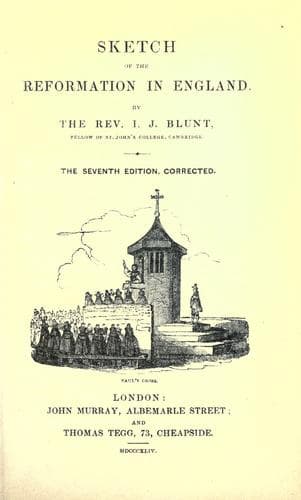
Sketch of the Reformation in EnglandBlunt, John J. (John James)
History
Sketch of the Reformation in England
Blunt, John J. (John James)
Great Britain -- Church history; Reformation -- England
If it was not Gardiner’s jealousy of Pole, who was to succeed
Cranmer in the primacy, which was the occasion of the archbishop’s
respite,[449] the plan of the persecution was arranged with consummate
sagacity. Ridley and Latimer were men of greater animal courage than
Cranmer; and would probably have sustained the insidious temptations
under which he sunk, or at any rate would have imparted their own
constancy to him, had they all suffered together. They, therefore were
taken, and he was left; for though the same legal form which served
for the despatch of the two former would not have sufficed for the
archbishop--it being reserved for the pope himself to take cognizance
of a metropolitan--yet inasmuch as all the parties had been prisoners
so long; ample time had been allowed for making the two processes run
together, and thereby bringing the three bishops together to the stake.
Cranmer, however, was assailed by a separate commission which issued
from the pope, as the other issued from the legate, and since a part of
the form consisted of a citation to appear at Rome within eighty days,
the final sentence was suspended till that period should have expired.
The citation itself was an affair of mere mockery, compliance with it
being impossible, for Cranmer was still detained a close prisoner.
The eighty days at an end, and he “having taken no care to appear at
Rome” (as the papal instrument had the modesty to word it), the pope
pronounces him guilty of heresy; and appoints Bonner Bishop of London,
and Thirlby Bishop of Ely, commissioners to see the same executed.
His degradation having been effected, attended by every aggravation of
insult which the ruthless Bonner could devise, he was delivered over
to the secular power, (the church, forsooth, shrinking from the office
of shedding blood,) to be put to death. One attempt more, however,
was yet to be made to shake the resolution of the martyr; and Cranmer
became the guest of the Dean of Christ Church, and delicate fare was
provided for him; and he played at bowls; and walked at his pleasure;
and wily men distilled their venom into his ear, that the King and
Queen desired his conversion above all things; that the council bore
him good will; that it was but a small thing to set his name to a few
words on a little leaf of paper; that he was not so old but that many
years yet remained of lusty age; that his notable learning, which
might profit so many, should not be extinguished before its time;
that if desire of life were nothing, yet that death is grievous, and
especially such a death; till Cranmer, who had stoutly withstood the
judgment-hall and prison-house, the scoffs and gibes of merciless men,
and all the terrible artillery of persecution in its most angry shape,
was not proof against these crafts and subtleties which the devil or
man wrought against him, and so signed his recantation. “To conceal
this fault,” may we say as Fuller does on the subscription of Jewel,
Public-domain text, read in full here on John Shaqi.
Reviews
Reviews
No reviews yet
Be the first to share your thoughts on this work.
Elsewhere in the archive
Join the Discussion
Join the discussion
Sign in to leave a comment or review.
Sign InorCreate an account