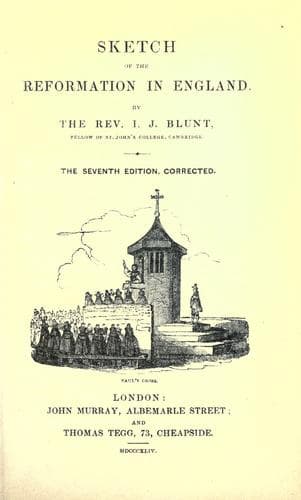
Sketch of the Reformation in EnglandBlunt, John J. (John James)
History
Sketch of the Reformation in England
Blunt, John J. (John James)
Great Britain -- Church history; Reformation -- England
[41] Bede, 94.
[42] Bede, 334. ed. Wheloc.
[43] Præfat. in Leges Aluredi Regis, p. 16. ed. Wheloc.
[44] Bede, 411.
[45] Bede, ed. Wheloc, p. 422. et seq.
[46] Turner’s Ang. Sax. iii. 362.
[47] Measure for Measure, act iii. sc. 1.
[48] Bede, 430.
[49] Bede, 336, 344, 349, 417.
[50] Bede, 164, 315, 431.
[51] This argument is actually urged in favour of the dignity of the
priesthood in the Catechismus ad Parochos, p. 270.
[52] Bede, 78.
[53] Bede, 124. This phrase, however, might only indicate the side
Eadbald would have supported in the Nestorian controversy.
[54] Bede, 446.
[55] Bede, 281.
[56] Bede, 185, 186.
[57] Bede, 351.
[58] Bede, 389.
[59] Bede, 366.
[60] Bede, 374.
[61] Bede, 213.
[62] Bede, p. 441. et seq. Comp. Dante Purgator. ii.
[63] See pp. 206. 329.
[64] Canonicus Lichfeld. de Success. Archiep. Cant. ap. Wharton, Anglia
Sacra, i. 95.
[65] Osbern. ap. Wharton, Angl. Sacr. ii. 89.
[66] Burnet’s Hist. Reform. v. i. 130. v. iii. introd. xvi. fol.
[67] In “The Supplication of Beggars,” they are stated at 52,000.
(See Fox’s Acts and Mon, ii. 280. edit. 1631–2, with the note.) The
number may be exaggerated; but it will seem less extraordinary when
it is remembered that one of the qualifications of a thegn or thane,
a lower class of nobles, having some analogy to the barons of Norman
times, was, that he should have five hides of his own land and a
_church_. (See Turner’s Angl. Sax. ii. 265.)
[68] Angl. Sacr. ii. 91.
[69] Hen. Wharton, Angl. Sacr. i. 126.
[70] Willelm. Malmesb. ap. Wharton, Angl. Sacr. ii. 260.
[71] See Warton’s Hist. of English Poetry, i. 266. 4to.
[72] Angl. Sacr. i. 435.
[73] Angl. Sacr. i. 255.
[74] Angl. Sacr. i. 248.
[75] Angl. Sacr. ii. præf. p. 4.
[76] Angl. Sacr. ii. 480.
[77] Angl. Sacr. ii. 611.
[78] Warton’s Hist. of Poetry, i. 290. 4to.
[79] Erasmi Colloq. Franciscani.
[80] See an Essay on the Government of the Church of England, by George
Reynolds, Archdeacon of Lincoln, p. 101. _et seq._
[81] Warton’s Hist. of English Poetry, i. 292. 4to.
[82] Ibid. i. 290.
[83] Warton’s Hist. of English Poetry, i. 296.
[84] Erasm. Colloq. Franciscani. Chaucer.
[85] Milton, i. 80. Prose Works, Burnett’s ed. Bishop Jewel argues
the question more practically than Milton; and, allowing that there
are many who would teach Christ for Christ’s sake, looks onward to
posterity, and asks of fathers, whether their own zeal will cause
them to “keep their children at school until four and twenty years
old, at their own charges, that in the end they may live in glorious
poverty? that they may live poorly and naked, like the prophets and
the apostles?” and he foretells that the event would be a lapse into
ignorance--Serm. on Ps. lxix. 9.
[86] Erasm. Colloq. Franciscani.
[87] Leges Inæ, 1. Aluredi, 23, 24. Edmundi, 57. Edgari, 62. Bede’s
Eccl. Hist. 178. 291. See also Sharon Turner’s Anglo-Saxons, iii. 248.
_et seq._
Public-domain text, read in full here on John Shaqi.
Reviews
Reviews
No reviews yet
Be the first to share your thoughts on this work.
Elsewhere in the archive
Join the Discussion
Join the discussion
Sign in to leave a comment or review.
Sign InorCreate an account