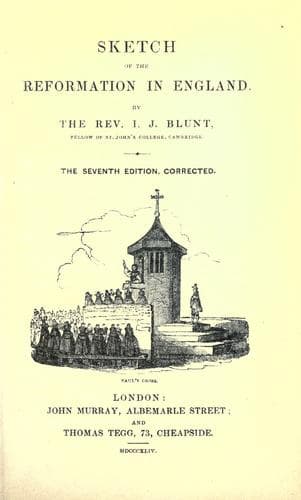
Sketch of the Reformation in EnglandBlunt, John J. (John James)
History
Sketch of the Reformation in England
Blunt, John J. (John James)
Great Britain -- Church history; Reformation -- England
Neither does it seem to be unmeet that they who are themselves
the “ministers of God,” (as St. Paul expressly calls the supreme
magistrates) the “powers ordained of God,” the men to whom “every
soul,” without any reservation of ecclesiastics, is to be subject
“because they are of God,” should have some voice in the approval
of the servants of God’s church, and some control over them; more
especially when it is remembered that it is the duty of a king to rule
well, and that it would be difficult for him to rule at all, with a
body of men within his realm and out of his own reach, who must always
possess, so long as the concerns of a world beyond the grave can touch
mankind, a very powerful lever in their hands, which, however honestly
it may be, and is in general applied, is nevertheless capable of
misapplication, as the history of every nation can testify, and none
more than our own.[243] And without any reference to extreme cases, to
the danger, for instance, of religious meetings becoming, in critical
seasons, schools of sedition, and of the divine resolving himself into
the demagogue; a danger, however, by no means chimerical when there is
nothing to connect the system of religious instruction with the office
of the civil magistrate; even in ordinary times it would be found, and
it has been found, that the spirit of the independent congregation
and that of the government under which it exists, but to which it
owes nothing, coincide but little--and that the state is apt to feel
its energies crippled by the positive opposition, or at least the
non-co-operation of these, its members, in their religious capacity.
It may be added, in defence of the consolidation of the supremacy, both
civil and ecclesiastical, in the king, that the Romanists themselves
could not deny that the early councils (the decrees of which are
recognised by the church of Rome to this day) were summoned by the
magistrate, and not by the Bishop of Rome; the council of Nice; for
example, by Constantine, “who called together a synod (they are the
words of Sozomen), and wrote letters to those who were set over the
churches, in every place to attend on a certain day--and there were
present (he adds) at this assembly, from the apostolic see, Macarius
of Jerusalem, Eustathius, the President of the church of Antioch, (who
is reported by Theodoret, it may be observed, as the leader of the
council, and the orator who opened it by an address to the emperor,)
Alexander of Alexandria, Biton and Bicentius, presbyters of the church
of Rome, Julius the bishop being absent, and in all, of bishops about
three hundred and twenty, and of presbyters and deacons who attended
them no small number.”[244]
Public-domain text, read in full here on John Shaqi.
Reviews
Reviews
No reviews yet
Be the first to share your thoughts on this work.
Elsewhere in the archive
Join the Discussion
Join the discussion
Sign in to leave a comment or review.
Sign InorCreate an account