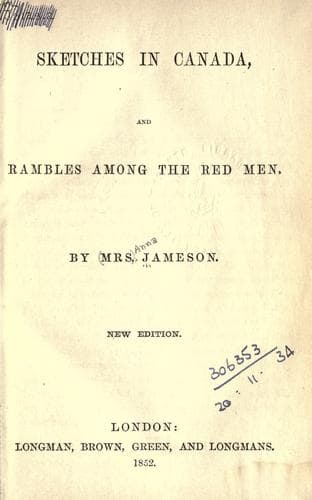
Sketches in Canada, and rambles among the red menJameson, Mrs. (Anna)
History
Sketches in Canada, and rambles among the red men
Jameson, Mrs. (Anna)
Indians of North America -- Canada; Ontario -- Description and travel
confines of civilisation, and their record is necessarily imperfect. It
is clear that he had entertained the daring and really magnificent plan
formerly embraced by Pontiac--that of uniting all the Indian tribes and
nations in a league against the whites. That he became the ally of the
British was not from friendship to us, but hatred to the Americans, whom
it was his first object to repel from any further encroachments on the
rights and territories of the Red men--in vain! These attempts of a
noble and a fated race, to oppose, or even to delay for a time, the
rolling westward of the great tide of civilisation, are like efforts to
dam up the rapids of Niagara. The moral world has its laws, fixed as
those of physical nature. The hunter must make way before the
agriculturist, and the Indian must learn to take the bit between his
teeth, and set his hand to the ploughshare, or _perish_. As yet I am
inclined to think that the idea of the Indians becoming what _we_ call
a civilised people seems quite hopeless; those who entertain such
benevolent anticipations should come here, and behold the effect which
three centuries of contact with the whites have produced on the nature
and habits of the Indian. The benevolent theorists in England should
come and see with their own eyes that there is a bar to the civilisation
of the Indians, and the increase or even preservation of their numbers,
which no power can overleap. Their own principle, that "the Great Spirit
did indeed create both the red man and the white man, but created them
essentially different in nature and manners," is not, perhaps, far from
the truth.
[Footnote 15: The war of 1812.]
MISSIONARIES AMONG THE INDIANS.
Take, for instance, the following scene, as described with great naïveté
by one of the Moravian missionaries. After a conference with some of the
Delaware chief men, in which they were informed that these missionaries
had come to teach them a better and purer religion, of which the one
fundamental principle, leading to eternal salvation, was belief in the
Redeemer, and atonement through his blood for the sins of all
mankind--all which was contained in the book which he held in his
hand,--"Wangoman, a great chief and medicine-man among them, rose to
reply. He began by tracing two lines on the ground, and endeavoured to
explain that there were two ways which led alike to God and to
happiness, the way of the Red man, and the way of the White man, but the
way of the Red man, he said, was the straighter and the shorter of the
two."
The missionary here interposed, and represented that God himself had
descended on earth to teach men the _true_ way. Wangoman declared that
"he had been intimately acquainted with God for many years, and had
never heard that God became a man and shed his blood, and therefore the
God of whom Brother Zeisberger preached could not be the true God, or
he, Wangoman, would have been made acquainted with the circumstance."
Public-domain text, read in full here on John Shaqi.
Reviews
Reviews
No reviews yet
Be the first to share your thoughts on this work.
Elsewhere in the archive
Join the Discussion
Join the discussion
Sign in to leave a comment or review.
Sign InorCreate an account