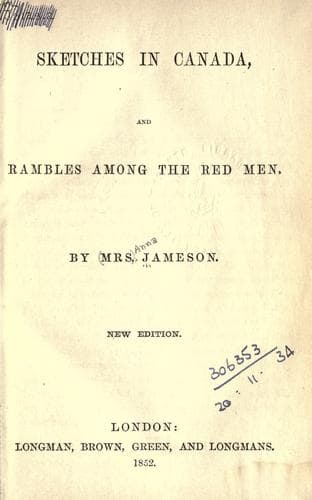
Sketches in Canada, and rambles among the red menJameson, Mrs. (Anna)
History
Sketches in Canada, and rambles among the red men
Jameson, Mrs. (Anna)
Indians of North America -- Canada; Ontario -- Description and travel
Signed by ten chiefs, or, more properly, chief men, of the tribe, of
whom one, the Beaver, signs his name in legible characters: the others,
as is usual with the Indians, affix each their _totem_, (crest or
sign-manual,) being a rude scratch of a bird, fish, deer, &c. Another of
these papers, similarly signed, contains a requisition for working tools
and mechanical instruments of various kinds. This looks well, and it
_is_ well; but what are the present state and probable progress of this
Chippewa settlement? Why, one half the number at least are half-caste,
and as the white population closes and thickens around them, we shall
see in another generation or two none of entire Indian blood; they will
become, at length, almost wholly amalgamated with the white people. Is
this _civilising the Indians_?[17] I should observe, that when an Indian
woman gives herself to a white man, she considers herself as his wife to
all intents and purposes. If forsaken by him, she considers herself as
injured, not disgraced. There are great numbers of white settlers and
traders along the borders living thus with Indian women. Some of these
have been persuaded by the missionaries or magistrates to go through the
ceremony of marriage; but the number is few in proportion.
You must not imagine, after all I have said, that I consider the Indians
as an inferior race, merely because they have no literature, no
luxuries, no steam-engines; nor yet, because they regard our superiority
in the arts with a sort of lofty indifference, which is neither contempt
nor stupidity, look upon them as being beyond the pale of our
sympathies. It is possible I may, on a nearer acquaintance, change my
opinion, but they do strike me as an _untamable_ race. I can no more
conceive a city filled with industrious Mohawks and Chippewas, than I
can imagine a flock of panthers browsing in a penfold.
The dirty, careless habits of the Indians, while sheltered only by the
bark-covered wigwam, matter very little. Living almost constantly in the
open air, and moving their dwellings perpetually from place to place,
the worst effects of dirt and negligence are neither perceived nor
experienced. But I have never heard of any attempt to make them
stationary and congregate in houses, that has not been followed by
disease and mortality, particularly among the children; a natural result
of close air, confinement, heat, and filth. In our endeavours to
civilise the Indians, we have not only to convince the mind and change
the habits, but to overcome a certain physical organisation to which
labour and constraint and confinement appear to be fatal. This cannot be
done in less than three generations, if at all, in the unmixed race; and
meantime--they perish!
Public-domain text, read in full here on John Shaqi.
Reviews
Reviews
No reviews yet
Be the first to share your thoughts on this work.
Elsewhere in the archive
Join the Discussion
Join the discussion
Sign in to leave a comment or review.
Sign InorCreate an account