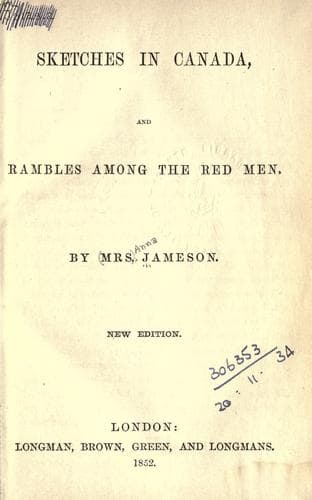
Sketches in Canada, and rambles among the red menJameson, Mrs. (Anna)
History
Sketches in Canada, and rambles among the red men
Jameson, Mrs. (Anna)
Indians of North America -- Canada; Ontario -- Description and travel
We took in at Chatham a large cargo of the usual articles of exportation
from Canada to the United States, viz. barrels of flour, sacks of grain,
and emigrants proceeding to Michigan and the Illinois. There are on
board, in the steerage, a great number of poor Scotch and Irish of the
lowest grade, and also one large family of American emigrants, who have
taken up their station on the deck, and whose operations amuse me
exceedingly. I wish I could place before you this very original ménage,
even as it is before me now while I write. Such a group could be
encountered nowhere on earth, methinks, but here in the west, or among
the migratory Tartar hordes of the east.
They are from Vermont, and on their way to the Illinois, having been
already eleven weeks travelling through New York and Upper Canada. They
have two waggons covered in with canvass, a yoke of oxen, and a pair of
horses. The chief or patriarch of the set is an old Vermont farmer,
upwards of sixty at least, whose thin shrewd face has been burnt to a
deep brick-dust colour by the sun and travel, and wrinkled by age or
care into a texture like that of tanned sail-canvass--(the simile
nearest to me at this moment). The sinews of his neck and hands are like
knotted whipcord; his turned-up nose, with large nostrils, snuffs the
wind, and his small light blue eyes have a most keen, cunning
expression. He wears a smockfrock over a flannel shirt, blue woollen
stockings, and a broken pipe stuck in his straw hat, and all day long he
smokes or chews tobacco. He has with him fifteen children of different
ages by three wives. The present wife, a delicate, intelligent,
care-worn woman, seems about thirty years younger than her helpmate. She
sits on the shaft of one of the waggons I have mentioned, a baby in her
lap, and two of the three younger children crawling about her feet. Her
time and attention are completely taken up in dispensing to the whole
brood, young and old, rations of food, consisting of lard, bread of
Indian corn, and pieces of sassafras root. The appearance of all (except
the poor anxious mother) is equally robust and cheerful, half-civilised,
coarse, and by no means clean: all are barefooted except the two eldest
girls, who are uncommonly handsome, with fine dark eyes. The eldest son,
a very young man, has been recently married to a very young wife, and
these two recline together all day, hand in hand, under the shade of a
sail, neither noticing the rest nor conversing with each other, but, as
it seems to me, in silent contentment with their lot. I found these
people, most unlike others of their class I have met with before,
neither curious nor communicative, answering to all my questions and
advances with cautious monosyllables, and the old man with even laconic
rudeness. The contrast which the gentle anxious wife and her baby
presented to all the others, interested me; but she looked so
overpowered by fatigue, and so disinclined to converse, that I found no
Public-domain text, read in full here on John Shaqi.
Reviews
Reviews
No reviews yet
Be the first to share your thoughts on this work.
Elsewhere in the archive
Join the Discussion
Join the discussion
Sign in to leave a comment or review.
Sign InorCreate an account