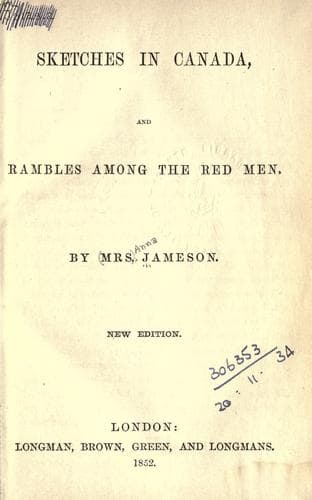
Sketches in Canada, and rambles among the red menJameson, Mrs. (Anna)
History
Sketches in Canada, and rambles among the red men
Jameson, Mrs. (Anna)
Indians of North America -- Canada; Ontario -- Description and travel
After some whispering among themselves, an orator of the party addressed
the commissioner with great emphasis. Extending his hand and raising his
voice, he began: "Father, I am come to tell you a piece of my mind." But
when he had uttered a few sentences, Mr. Schoolcraft desired the
interpreter to tell him that it was useless to speak farther on _that_
subject, (I understood it to relate to some land-payments). The orator
stopped immediately, and then, after a pause, he went up and took Mr.
Schoolcraft's hand with a friendly air, as if to show he was not
offended. Another orator then arose, and proceeded to the object of the
visit, which was to ask an allowance of corn, salt, and tobacco, while
they remained on the island, a request which I presume was granted, as
they departed with much apparent satisfaction.
There was not a figure among them that was not a study for a painter;
and how I wished that my hand had been readier with the pencil to snatch
some of those picturesque heads and attitudes. But it was all so new. I
was so lost in gazing, listening, observing, and trying to comprehend,
that I could not make a single sketch, except the above, in most poor
and inadequate words.
* * * * *
The Indians here--and fresh parties are constantly arriving--are chiefly
Ottawas, from Arbre Croche, on the east of Lake Michigan;
Pottowottomies; and Winnebagos from the west of the lake; a few
Menomonies and Chippewas from the shores north-west of us; the occasion
of this assemblage being the same with all. They are on the way to the
Manitoolin Islands, to receive the presents annually distributed by the
British government to all those Indian tribes who were friendly to us
during the wars with America, and call themselves our allies and our
children, though living within the bounds of another state. Some of them
make a voyage of five hundred miles to receive a few blankets and
kettles; coasting along the shores, encamping at night, and paddling all
day from sunrise to sunset, living on the fish or game they may meet,
and the little provision they can carry with them, which consists
chiefly of parched Indian corn and bear's fat. Some are out on this
excursion during six weeks, or more, every year; returning to their
hunting grounds by the end of September, when the great hunting season
begins, which continues through October and November; they then return
to their villages and wintering grounds. This applies generally to the
tribes I find here, except the Ottawas of Arbre Croche, who have a good
deal of land in cultivation, and are more stationary and civilised than
the other Lake Indians. They have been for nearly a century under the
care of the French Jesuit missions, but do not seem to have made much
advance since Henry's time, and the days when they were organised under
Pontiac; they were even then considered superior in humanity and
intelligence to the Chippewas and Pottowottomies, and more inclined to
agriculture.
Public-domain text, read in full here on John Shaqi.
Reviews
Reviews
No reviews yet
Be the first to share your thoughts on this work.
Elsewhere in the archive
Join the Discussion
Join the discussion
Sign in to leave a comment or review.
Sign InorCreate an account