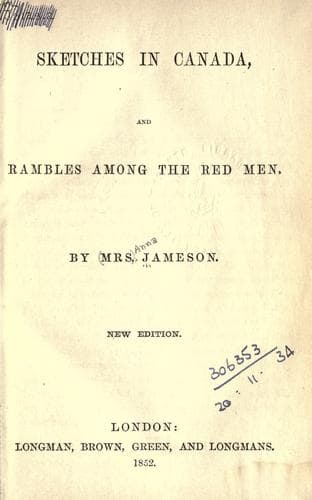
Sketches in Canada, and rambles among the red menJameson, Mrs. (Anna)
History
Sketches in Canada, and rambles among the red men
Jameson, Mrs. (Anna)
Indians of North America -- Canada; Ontario -- Description and travel
The most delightful as well as most profitable hours I spent here, are
those passed in the society of Mrs. Schoolcraft. Her genuine refinement
and simplicity, and native taste for literature, are charming; and the
exceeding delicacy of her health, and the trials to which it is exposed,
interest all my womanly sympathies. While in conversation with her, new
ideas of the Indian character suggest themselves; new sources of
information are opened to me, such as are granted to few, and such as I
gratefully appreciate. She is proud of her Indian origin; she takes an
enthusiastic and enlightened interest in the welfare of her people, and
in their conversion to Christianity, being herself most unaffectedly
pious. But there is a melancholy and pity in her voice, when speaking of
them, as if she did indeed consider them a doomed race. We were
conversing to-day of her grandfather, Waub-Ojeeg, (the White-fisher), a
distinguished Chippewa chief and warrior, of whose life and exploits she
has promised to give me some connected particulars. Of her mother,
O,shah,gush,ko,da,wa,qua, she speaks with fond and even longing
affection, as if the very sight of this beloved mother would be
sufficient to restore her to health and strength. "I should be well if I
could see my mother," seems the predominant feeling. Nowhere is the
instinctive affection between parent and child so strong, so deep, so
sacred, as among these people.
Celibacy in either sex is almost unknown among the Indians; equally rare
is all profligate excess. One instance I heard of a woman who had
remained unmarried from choice, not from accident or necessity. In
consequence of a dream in early youth (the Indians are great dreamers),
she not only regarded the sun as her manito or tutelary spirit (this had
been a common case), but considered herself especially dedicated, or in
fact married, to the luminary. She lived alone; she had built a wigwam
for herself, which was remarkably neat and commodious; she could use a
rifle, hunt, and provide herself with food and clothing. She had carved
a rude image of the sun, and set it up in her lodge; the husband's
place, the best mat, and a portion of food, were always appropriated to
this image. She lived to a great age, and no one ever interfered with
her mode of life, for that would have been contrary to all their ideas
of individual freedom. Suppose that, according to our most approved
European notions, the poor woman had been burnt at the stake,
corporeally or metaphorically, or hunted beyond the pale of the village,
for deviating from the law of custom, no doubt there would have been
directly a new female sect in the nation of the Chippewas, an order of
_wives of the sun_, and Chippewa vestal virgins; but these wise people
trusted to nature and common sense. The vocation apparently was not
generally admired, and found no imitators.
Public-domain text, read in full here on John Shaqi.
Reviews
Reviews
No reviews yet
Be the first to share your thoughts on this work.
Elsewhere in the archive
Join the Discussion
Join the discussion
Sign in to leave a comment or review.
Sign InorCreate an account