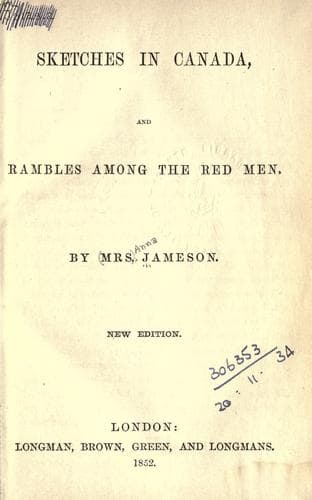
Sketches in Canada, and rambles among the red menJameson, Mrs. (Anna)
History
Sketches in Canada, and rambles among the red men
Jameson, Mrs. (Anna)
Indians of North America -- Canada; Ontario -- Description and travel
The Indians have a very fanciful mythology, which would make exquisite
machinery for poetry. It is quite distinct from the polytheism of the
Greeks. The Greek mythology personified all nature, and materialised all
abstractions: the Indians spiritualise all nature. They do not indeed
place dryads and fauns in their woods, nor naiads in their streams; but
every tree has a spirit; every rock, every river, every star that
glistens, every wind that breathes, has a spirit; every thing they
cannot comprehend is a spirit: this is the ready solution of every
mystery, or rather makes every thing around them a mystery as great as
the blending of soul and body in humanity. A watch, a compass, a gun,
have each their spirit. The thunder is an angry spirit; the aurora
borealis, dancing and rejoicing spirits; the milky way is the path of
spirits. Birds, perhaps from their aerial movements, they consider as in
some way particularly connected with the invisible world of spirits. Not
only all animals have souls, but it is the settled belief of the
Chippewa Indians that their souls will fare the better in another world,
in the precise ratio that their lives and enjoyments are curtailed in
this: hence, they have no remorse in hunting; but when they have killed
a bear or rattle-snake, they solemnly beg his pardon, and excuse
themselves on the plea of necessity.
Besides this general _spiritualisation_ of the whole universe, which to
an Indian is all spirit in diversity of forms (how delighted Bishop
Berkeley would have been with them!), they have certain mythologic
existences. Manabozho is a being very analogous to the Seeva of the
Hindoo mythology. The four cardinal points are spirits, the west being
the oldest and the father of the others, by a beautiful girl, who, one
day while bathing, suffered the west wind to blow upon her. Weeng is the
spirit of sleep, with numerous little subordinate spirits, his
emissaries, whose employment is to close the eyes of mortals, and by
tapping on their foreheads _knock_ them to sleep. Then they have
Weendigos--great giants and cannibals, like the Ascaparts and Morgantes
of the old romances; and little tiny spirits or fairies, which haunt
the woods and cataracts. The Nibanàba, half human half fish, dwell in
the waters of Lake Superior. Ghosts are plentiful, and so are
transformations, as you have seen. The racoon was once a shell lying on
the lake shore, and vivified by the sun-beams: the Indian name of the
racoon, _aisebun_, is literally, _he was a shell_. The brains of a
wicked adulteress, whose skull was beaten to pieces against the rocks,
as it tumbled down a cataract, became the white fish.[30]
Public-domain text, read in full here on John Shaqi.
Reviews
Reviews
No reviews yet
Be the first to share your thoughts on this work.
Elsewhere in the archive
Join the Discussion
Join the discussion
Sign in to leave a comment or review.
Sign InorCreate an account