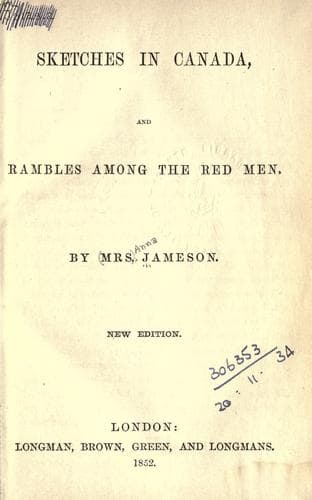
Sketches in Canada, and rambles among the red menJameson, Mrs. (Anna)
History
Sketches in Canada, and rambles among the red men
Jameson, Mrs. (Anna)
Indians of North America -- Canada; Ontario -- Description and travel
The proposition made to them was evidently displeasing. The orator,
after whispering with the chief, made a long and vehement speech in a
loud emphatic voice, and at every pause the auditors exclaimed, "Hah!"
in sign of approbation. I remarked that he sometimes made a jest which
called forth a general smile, even from the interpreter and Mr.
Schoolcraft. Only a few sentences were translated: from which I
understood that they all considered this offer as a violation of the
treaty which their great father at Washington, the president, had made
with them. They did not want goods,--they wanted the stipulated dollars.
Many of their young men had procured goods from the traders on credit,
and depended on the money due to them to discharge their debts; and, in
short, the refusal was distinct and decided. I am afraid, however, it
will not avail them much.[33] The mean, petty-trader style in which the
American officials make (and _break_) their treaties with the Indians is
shameful. I met with none who attempted to deny it or excuse it. Mr.
Schoolcraft told me that during the time he had been Indian agent
(five-and-twenty years) he had never known the Indians to violate a
treaty or break a promise. He could not say the same of his government,
and the present business appeared most distasteful to him; but he was
obliged to obey the order from the head of his department.
The Indians themselves make witty jests on the bad faith of the "Big
Knives."[34] "My father!" said a distinguished Pottowottomie chief at
the treaty of Chicago--"my father, you have made several promises to
your red children, and you have put the money down upon the table: but
as fast as you put it upon the top, it has slipped away to the bottom,
in a manner that is incomprehensible to us. We do not know what becomes
of it. When we get together, and divide it among ourselves, it is
nothing! and we remain as poor as ever. My father, I only explain to you
the words of my brethren. We can only see what is before our eyes, and
are unable to comprehend all things." Then pointing to a newspaper which
lay on the table--"You see that paper on the table before you--it is
double. You can see what is upon the upper sheet, but you cannot see
what is below. We cannot tell how our money goes!"
Public-domain text, read in full here on John Shaqi.
Reviews
Reviews
No reviews yet
Be the first to share your thoughts on this work.
Elsewhere in the archive
Join the Discussion
Join the discussion
Sign in to leave a comment or review.
Sign InorCreate an account