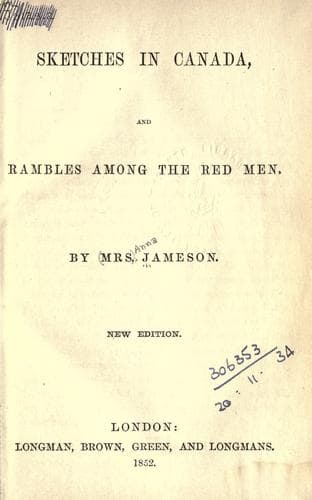
Sketches in Canada, and rambles among the red menJameson, Mrs. (Anna)
History
Sketches in Canada, and rambles among the red men
Jameson, Mrs. (Anna)
Indians of North America -- Canada; Ontario -- Description and travel
Enough of solemn reveries on starlit lakes--enough--too much--of self
and self-communings; I turn over a new leaf, and this shall be a chapter
of geography, and topography, natural philosophy, and such wise-like
things. Draw the curtain first, for if I look out any longer on those
surging rapids, I shall certainly turn giddy--forget all the memoranda
I have been collecting for you, lose my reckoning, and become
unintelligible to you and myself too.
This river of St. Mary is, like the Detroit and the St. Clair, already
described, properly a strait, the channel of communication between Lake
Superior and Lake Huron. About ten miles higher up, the great ocean-lake
narrows to a point; then, forcing a channel through the high lands,
comes rushing along till it meets with a downward ledge, or cliff, over
which it throws itself in foam and fury, tearing a path for its billows
through the rocks. The descent is about twenty-seven feet in three
quarters of a mile, but the rush begins above, and the tumult continues
below the fall, so that, on the whole, the eye embraces an expanse of
white foam measuring about a mile each way, the effect being exactly
that of the ocean breaking on a rocky shore: not so terrific, nor on so
large a scale, as the rapids of Niagara, but quite as beautiful--quite
as animated.
What the French call a _saut_ (leap), we term a _fall_; the
Sault-Sainte-Marie is translated into the falls of St. Mary. By this
name the rapids are often mentioned, but the village on their shore
still retains its old name, and is called the Sault. I do not know why
the beautiful river and its glorious cataracts should have been placed
under the peculiar patronage of the blessed Virgin; perhaps from the
union of exceeding loveliness with irresistible power; or, more
probably, because the first adventurers reached the spot on some day
hallowed in the calendar.
The French, ever active and enterprising, were the first who penetrated
to this wild region. They had an important trading post here early in
the last century, and also a small fort. They were ceded, with the rest
of the country, to Great Britain, in 1762.[36] I wonder whether, at that
time, the young king or any of his ministers had the least conception of
the value and immensity of the magnificent country thrown into our
possession, or gave a thought to the responsibilities it brought with
it!--to be sure they made good haste, both king and ministers, to get
rid of most of the responsibility. The American war began, and at its
conclusion the south shore of St. Mary's, and the fort, were surrendered
to the Americans.
Public-domain text, read in full here on John Shaqi.
Reviews
Reviews
No reviews yet
Be the first to share your thoughts on this work.
Elsewhere in the archive
Join the Discussion
Join the discussion
Sign in to leave a comment or review.
Sign InorCreate an account