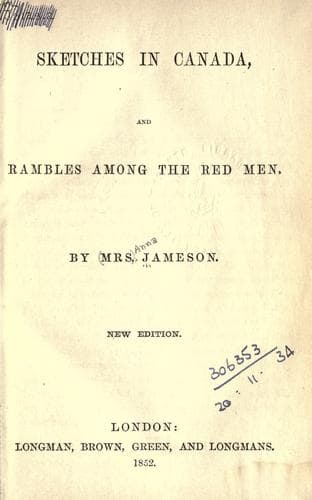
Sketches in Canada, and rambles among the red menJameson, Mrs. (Anna)
History
Sketches in Canada, and rambles among the red men
Jameson, Mrs. (Anna)
Indians of North America -- Canada; Ontario -- Description and travel
On the Canada side we have not even these demonstrations of power or
prosperity. Nearly opposite to the American fort there is a small
factory belonging to the North-west Fur Company; below this, a few
miserable log-huts, occupied by some French Canadians and voyageurs in
the service of the company, a set of lawless _mauvais sujets_, from all
I can learn. Lower down stands the house of Mr. and Mrs. MacMurray, with
the Chippewa village under their care and tuition; but most of the
wigwams and their inhabitants are now on their way down the lake, to
join the congress at the Manitoolin Islands. A lofty eminence, partly
cleared and partly clothed with forest, rises behind the house, on which
stand the little missionary church and school-house for the use of the
Indian converts. From the summit of this hill you look over the traverse
into Lake Superior, and the two giant capes which guard its entrance.
One of these capes is called Gros-Cap, from its bold and lofty cliffs,
the yet unviolated haunt of the eagle. The opposite cape is more
accessible, and bears an Indian name, which I cannot pretend to spell,
but which signifies "the place of the Iroquois' bones:" it was the scene
of a wild and terrific tradition. At the time that the Iroquois (or Six
Nations) were driven before the French and Hurons up to the western
lakes, they endeavoured to possess themselves of the hunting-grounds of
the Chippewas, and hence a bitter and lasting feud between the two
nations. The Iroquois, after defeating the Chippewas, encamped, a
thousand strong, upon this point, where, thinking themselves secure,
they made a war feast to torture and devour their prisoners. The
Chippewas, from the opposite shore, beheld the sufferings and
humiliation of their friends, and, roused to sudden fury by the sight,
collected their warriors, only three hundred in all, crossed the
channel, and at break of day fell upon the Iroquois, now sleeping after
their horrible excesses, and massacred every one of them, men, women,
and children. Of their own party they lost but one warrior, who was
stabbed with an awl by an old woman who was sitting at the entrance of
her wigwam, stitching moccasins: thus runs the tale. The bodies were
left to bleach on the shore, and they say that bones and skulls are
still found there.
THE WHITE-FISH.
Public-domain text, read in full here on John Shaqi.
Reviews
Reviews
No reviews yet
Be the first to share your thoughts on this work.
Elsewhere in the archive
Join the Discussion
Join the discussion
Sign in to leave a comment or review.
Sign InorCreate an account