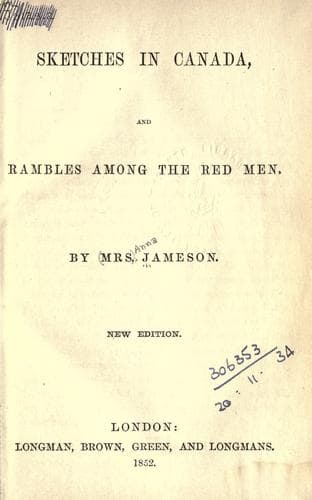
Sketches in Canada, and rambles among the red menJameson, Mrs. (Anna)
History
Sketches in Canada, and rambles among the red men
Jameson, Mrs. (Anna)
Indians of North America -- Canada; Ontario -- Description and travel
Just above the fort is the ancient burial-place of the Chippewas. I need
not tell you of the profound veneration with which all the Indian tribes
regard the places of their dead. In all their treaties for the cession
of their lands, they stipulate with the white man for the inviolability
of their sepulchres. They did the same with regard to this place, but I
am sorry to say that it has not been attended to, for in enlarging one
side of the fort, they have considerably encroached on the cemetery. The
outrage excited both the sorrow and indignation of some of my friends
here, but there is no redress. Perhaps it was this circumstance that
gave rise to the allusion of the Indian chief here, when in speaking of
the French he said, "_They_ never molested the places of our dead!"
The view of the rapids from this spot is inexpressibly beautiful, and it
has besides another attraction, which makes it to me a frequent lounge
whenever I cross the river;--but of this by-and-bye. To complete my
sketch of the localities, I will only add, that the whole country around
is in its primitive state, covered with the interminable swamp and
forest, where the bear and the moose-deer roam--and lakes and living
streams where the beaver builds his hut.[39] The cariboo, or rein-deer,
is still found on the northern shores.
The hunting-grounds of the Chippewas are in the immediate neighbourhood,
and extend all round Lake Superior. Beyond these, on the north, are the
Chippewyans; and on the south, the Sioux, Ottagamies, and
Pottowottomies.
I might here multiply facts and details, but I have been obliged to
throw these particulars together in haste, just to give you an idea of
my present situation. Time presses, and my sojourn in this remote and
interesting spot is like to be of short duration.
[Footnote 38: I spell the word as pronounced, never having seen it
written.]
[Footnote 39: The beaver is, however, becoming rare in these regions. It
is a curious fact connected with the physiology and psychology of
instinct, that the beaver is found to change its instincts and modes of
life, as it has been more and more persecuted, and, instead of being a
gregarious, it is now a solitary animal. The beavers, which are found
living in solitary holes instead of communities and villages, the
Indians call by a name which signifies _Old Bachelor_.]
* * * * *
MRS. JOHNSTON.
Public-domain text, read in full here on John Shaqi.
Reviews
Reviews
No reviews yet
Be the first to share your thoughts on this work.
Elsewhere in the archive
Join the Discussion
Join the discussion
Sign in to leave a comment or review.
Sign InorCreate an account