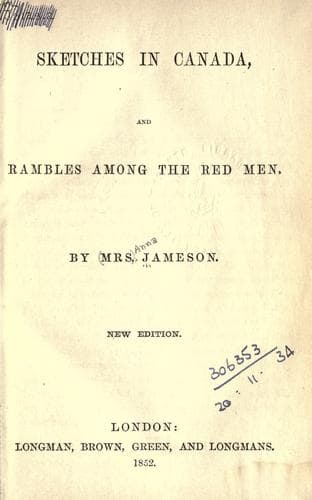
Sketches in Canada, and rambles among the red menJameson, Mrs. (Anna)
History
Sketches in Canada, and rambles among the red men
Jameson, Mrs. (Anna)
Indians of North America -- Canada; Ontario -- Description and travel
[Footnote 40: "The whole history of Indian warfare," says Mr.
Schoolcraft, "might be challenged in vain for a solitary instance of
this kind. The Indians believe that to take a dishonourable advantage of
their female prisoners would destroy their luck in hunting; it would be
considered as effeminate and degrading in a warrior, and render him
unfit for, and unworthy of, all manly achievement."]
THE SAVAGE AND THE CHRISTIAN.
To return to the Indians. After telling me some other particulars, which
gave me a clearer view of their notions and feelings on these points
than I ever had before, my informant mildly added,--"It is a constant
and favourite subject of reproach against the Indians--this barbarism of
their desultory warfare; but I should think more women and children have
perished in _one_ of your civilised sieges, and that in late times, than
during the whole war between the Chippewas and Sioux, and _that_ has
lasted a century."
I was silent, for there is a sensible proverb about taking care of our
own glass windows: and I wonder if any of the recorded atrocities of
Indian warfare or Indian vengeance, or all of them together, ever
exceeded Massena's retreat from Portugal,--and the French call
themselves civilised. A war party of Indians, perhaps two or three
hundred (and that is a very large number), dance their war dance, go out
and burn a village, and bring back twenty or thirty scalps. _They_ are
savages and heathens. We Europeans fight a battle, leave fifty thousand
dead or dying by inches on the field, and a hundred thousand to mourn
them, desolate; but _we_ are civilised and Christians. Then only look
into the motives and causes of our bloodiest European wars as revealed
in the private history of courts:--the miserable, puerile, degrading
intrigues which set man against man--so horridly disproportioned to the
horrid result! and then see the Indian take up his war-hatchet in
vengeance for some personal injury, or from motives that rouse all the
natural feelings of the natural man within him! Really I do not see that
an Indian warrior, flourishing his tomahawk, and smeared with his
enemy's blood, is so very much a greater savage than the pipe-clayed,
padded, embroidered personage, who, without cause or motive, has sold
himself to slay or be slain: one scalps his enemy, the other rips him
open with a sabre; one smashes his brains with a tomahawk, and the other
blows him to atoms with a cannon-ball: and to me, femininely speaking,
there is not a needle's point difference between the one and the other.
If war be unchristian and barbarous, then war as a _science_ is more
absurd, unnatural, unchristian than war as a _passion_.
This, perhaps, is putting it all too strongly, and a little
exaggerated--
Public-domain text, read in full here on John Shaqi.
Reviews
Reviews
No reviews yet
Be the first to share your thoughts on this work.
Elsewhere in the archive
Join the Discussion
Join the discussion
Sign in to leave a comment or review.
Sign InorCreate an account